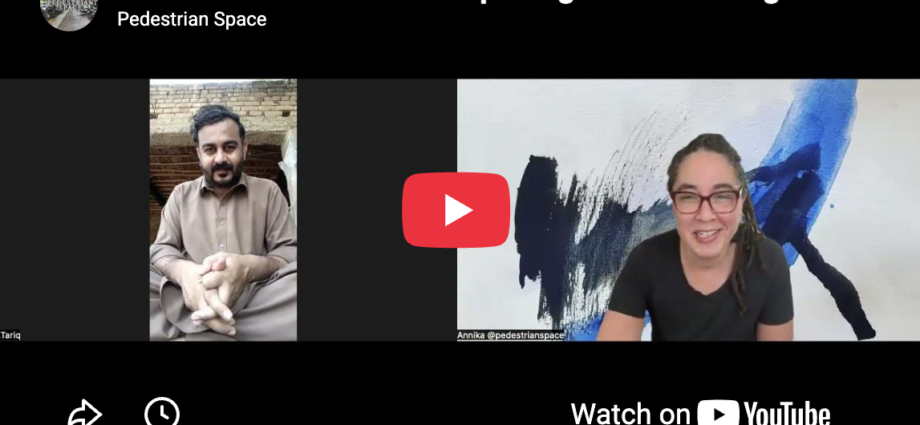
As part of the Pedestrian Space Global URBAN HEAT Media Lab and network in development, we are recording our conversations with incoming collaborators around the world as well as students interested in pursuing academic internships related to the project.
Today we met with Assistant Professor Muhammad Tariq, based in Peshawar.
He reached out to us about our Urban Heat pilot as it sits squarely in the work he does in Khyber Pakhtunkhwa, Pakistan, and was interested in joining as one of our city collaborators.
Tariq teaches architecture and urban ecology at CECOS University in Peshawar and runs EcoKoor, a climate-design practice focused on urban cooling and nature-based solutions in this region. His academic path was shaped by the Erasmus Mundus Joint Master’s in Urban Climate and Sustainability (MUrCS), and he studied across Glasgow Caledonian University, LAB University of Applied Sciences Lahti, and the University of Huelva, with a nature-based solutions module at HTW Dresden.
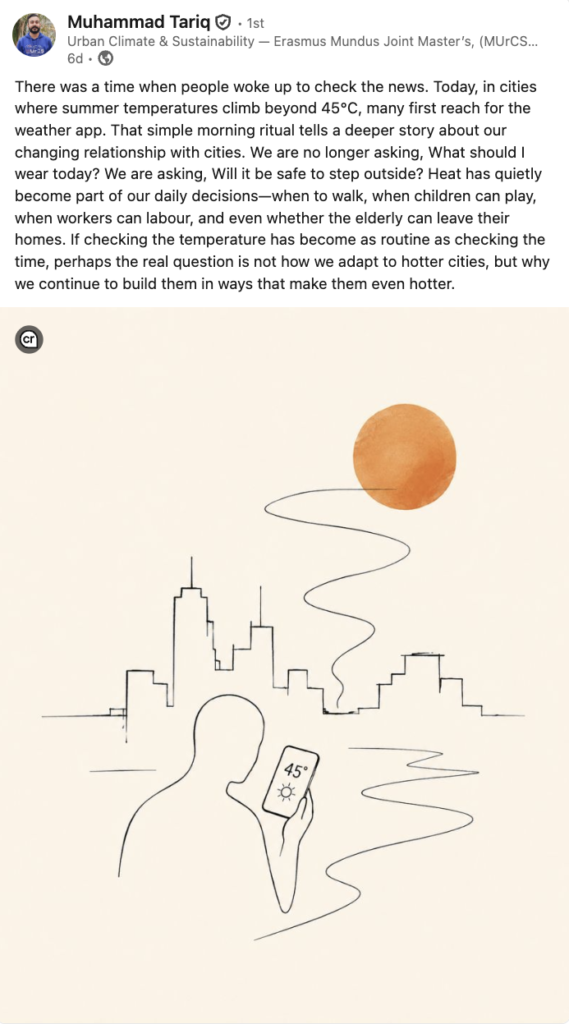
His master’s thesis was a comparative analysis of the cooling effects of different green infrastructure types on microclimate in Peshawar’s public squares — which is really the seed of everything he has worked on since. He has field-documented a taxonomy of 33 indigenous passive cooling typologies across 10+ sites in KPK (spatial, material, ventilation, vegetative, and behavioral strategies communities already use to cope with heat), which maps closely to two of your four pillars: lived experience/adaptation and educator activities. He has also crowdsourced thermal-refuge mapping prototype for Peshawar that speaks to the public-engagement piece.
View more about the Pedestrian Space ‘Global URBAN HEAT Media Lab’ project and network below.