Pilot 2027: Global URBAN HEAT Media Lab


At Pedestrian Space, we are developing the ‘Sustainable Urbanism & Planetary Health’ program and curriculum, with activities piloting in 2026 with collaborators in cities worldwide.

As part of this program, we are expanding our outreach and engagement with a pilot focused on the topic and issue of URBAN HEAT.

We welcome diverse forms of collaboration for this pilot, including with students, municipalities, educators, researchers, fellow organizations, and more.

We announced this pilot on LinkedIn on July 22, 2026, here, and were impressed by the flood of responses, which also illustrates how critical and widespread the issue is. Many university students, scholars, and professionals have written to collaborate and participate, conveying, I believe, the great interest and commitment that people specializing in urban issues have for this critical issue. 

Update on the foundation & development of the ‘Global URBAN HEAT Media Lab’, August 17, 2026

Due to such a tremendous response, as well as the reality that we are an NGO and platform focused on the intersection of media, research, communication and public engagement, for this pilot, we are planning a network approach and a ‘Global URBAN HEAT Media Lab’.
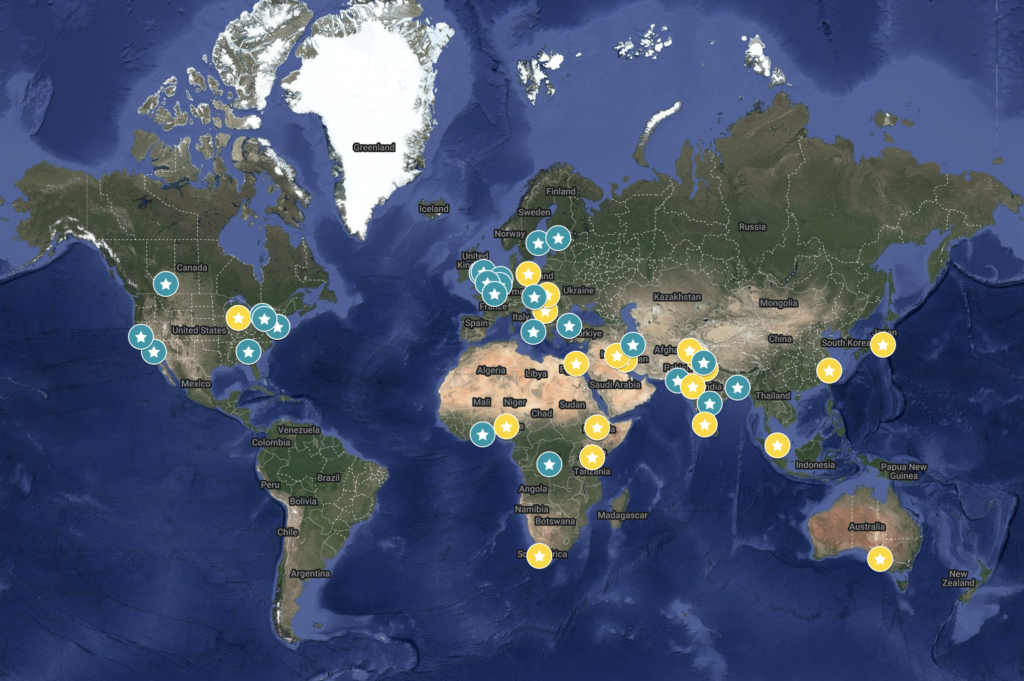
1-month-old network
The network in development as of August 30, 2026.

Turquoise circled stars represent academic interns/placements, and yellow circled stars represent professionals/collaborators

The Lab will include, but not be limited to:

  • Documenting municipal barriers, insights, and strategies for mitigating and reducing urban heat
  • Community-engaged research and projects that document the lived experiences and observations of residents adapting to urban heat
  • Media outreach and public engagement in shaping awareness on issues of urban heat
  • Co-creation of activities and exercises for educators to engage students in co-learning on issues of urban heat
  • Academic internships on diverse issues of urban heat
  • Case studies of cities and regions

We welcome collaborators from around the world, understanding the issue of urban heat as one of escalating urgency, affecting environmental and ecological health, public health, migration of species (including humans), daily quality of life, and increasingly testing the viability of our ‘habitats’.
We also host academic interns at Pedestrian Space and have been in the process, between July and August 2027 of accepting many students globally from diverse disciplines for Urban Heat-related internships and to study a range of issues of urban resilience via different disciplinary lenses.
Additionally, the academic experience of this project is not limited to academic placement but also includes an interdisciplinary workshop that we offer to facilitate via guest lectureships at universities.

More information on the workshop concept at this page
Learn more about the workshop for universities

If you are interested in learning more, please email us at info@pedestrianspace.org

-Annika, Founder at Pedestrian Space
The first cohort of the International Internship Network includes undergraduate and graduate students from cities and countries all over the world, and the network experience is designed to allow for independent inquiries and projects as well as collaboration at local, regional, and international levels with other Urban Heat Media Lab academic interns.

The URBAN HEAT BEAT

The following are recordings from conversations we have been having with individuals who are joining the Pedestrian Space URBAN HEAT pilot program 2026/27 as well as various posts by collaborators.

Stay tuned as we continuously update this page with recordings and post that are meant to highlight the diverse expertise, interests, and passions that individuals worldwide who are joining the Pedestrian Space ‘Global URBAN HEAT Media Lab’ pilot and network us have for committing energy to working on intersecting issues of urban resilience and environmental health.

Talk with Sonora, based in Brussels (August 2026). View here

Sonora Ward is an MSc Urban Studies student and Global Studies graduate based in Brussels and specializing in Sustainability science, and dedicated to issues of climate change and social injustice. Her current MSc thesis focuses on community-centered coastal nature-based solutions in metropolitan Barcelona, exploring how dune restoration and native plant introduction can protect marginalized communities from heat and coastal hazards. She notes that ‘This work strengthens my understanding of climate adaptation, environmental justice, and the need for inclusive governance. I believe this emphasis is essential for meaningful green transitions and aligns with Pedestrian Space’s work on urban heat and planetary health.

View more about the talk with Sonora here


Post by Patiala-based network participant Priyanshu Joshi (LinkedIn, August 2026), original post here

Talk with Serena, based in Leiden (August 2026). View here

Serena Claggett is a bachelor’s student at Leiden University in the Netherlands, studying sociology with an emphasis on sustainable communities and a minor in economics. Serena reflected that as an intern for the Pedestrian Space ‘Global URBAN HEAT Media Lab’ project, she wishes to develop knowledge that can make a difference in how people interact with their environments and refine her advocacy efforts for climate justice, urban mobility, and community development in embedded local contexts.

View talk with Serena here


Post by Calabria-based network participant Emre Gulebaglan (LinkedIn, August 2026)

Talk with Iqra, based in Delhi (August 2026). View here

Iqra Fatima is a third-year undergraduate student pursuing a B.A. (Hons.) in Geography with a Minor in Economics at Jamia Millia Islamia, New Delhi.

She notes that, ‘Being a resident of New Delhi, a city that increasingly experiences the challenges of urban heat, I am especially interested in understanding and contributing to initiatives that promote more sustainable, resilient, and people-centered urban environments.’ In this recorded clip, she reflects on intersecting issues of urban heat and climate change, migration, economic development, and quality of life.

View talk with Iqra here


Talk with Alisher, based in Toronto (August 2026). View here

 Alisher Kulzhabayev, is an incoming Master of Environmental Studies (Planning) student at York University in Toronto, Canada (as of August 2026). His academic and research background is centered on urban planning, public space, transportation, and community well-being. He notes that his study and work experiences have developed his interest in how the built environment shapes everyday experiences and how planning can support more resilient and inclusive communities. He is particularly interested in exploring urban heat through the intersections of public space, mobility, built form, and nature, and contributing a planning and research perspective to Pedestrian Space’s Sustainable Urbanism & Planetary Health initiative.

View talk with Alisher here


Post by Tokyo-based collaborator Rui Izumiyama, View on LinkedIn here (August 2026)

Tokyo-based Associate Professor Rui Izumiyama is taking part in the ‘Global URBAN HEAT Media Lab’ as a city collaborator, contributing through the research of Urban Design and Planning (Izumiyama Lab) at Nihon University. He hopes to bring a combination that he views as distinctive to Japan: heat mitigation approached not as an isolated environmental problem, but through walkable cities, placemaking, tactical urbanism, and area-based management, place management— building both the methods and the ecosystem of actors needed to make streets liveable in extreme summers.

One question he is particularly keen to compare across the network is who actually creates shade in a city, who funds it, and who maintains it? In Japan he notes that it is often area management organisations and private actors rather than municipalities and he is interested in comparison with other cities and countries.


Talk with Oliver, based in Leeds and Manchester, (August 2026). View here

Oliver Barnes is a student currently in the integrated MArch & MEng in Architecture and Engineering at the University of Leeds with interests at the intersection of sustainability, bio-inspired design, urban resilience, and innovative approaches to the built environment.

Oliver notes: “Urban heat sits at the intersection of many issues that I’m personally interested in. Climate resilience, public health, urban design, material performance. I see my background in architecture and engineering as an intersection that can be applied to this. What attracts me to Pedestrian Space and their research into urban heat is that they look at these issues holistically rather than through a single disciplinary lens. And so, having this knowledge of different areas is something that’s really positive because that way you can communicate better, and through communication comes change.

View more on the talk with Oliver here


Talk with Emma Maria, based in Vienna (August 2026). View here

Emma Maria is an MSc student in socio-ecological economics and policy at WU Wien. During her studies in socio-ecological economics, she became increasingly interested in the concepts of social urbanism, heat gentrification, intersectional urbanism, and social municipality. She joins the ‘Global URBAN HEAT Media Lab’ with a deep interest in developing intersectional solutions to urban heat, as well as connecting to work mapping social vulnerability to heat exposure.

Read more on the August 2026 talk with Emma Maria here


Talk with Bryant, based in Irvine (August 2026). View here

Bryant Leung is an undergraduate student at UC Irvine, studying urban planning with a focus on urban design, architecture, climate adaptation, and environmental justice. He notes in this conversation and video that ‘Urban heat feels like the most urgent and important climate challenge that we’ve seen and it’s not just about temperature but also who can safely walk from one place to another.’

He joins the ‘Global URBAN HEAT Media Lab’ network with interest in exploring how design and planning interventions—such as urban greening, shading strategies, and mobility systems—can mitigate urban heat while supporting equitable outcomes.

Read more on the August 2026 talk with Bryant here


Talk with Eva, based in Atlanta (August 2026). View here

Eva Chauveau is an Urban Planner in Atlanta, Georgia, and also in the process of getting an MSc in Global Development from the Georgia Institute of Technology. She is working on an Urban Heat Mitigation and Action Plan for DeKalb County and joins the Global URBAN HEAT Media Lab and network as she gathers data for their Action Plan, also viewing the network as an amazing learning opportunity to better understand how to synthesize strategies for regions facing an urban heat crisis.

Read more on the August 2026 talk with Eva here


Talk with Hamissou, based in Minna (August 2026). View here

Niger-based Hamissou Saminou is a PhD Student in Climate Change and Human Habitat at the Federal University of Technology, Minna, Nigeria. His work examines how migration-driven urbanization and land-use and land-cover change influence urban heat island effects in Lagos, Nigeria, and Niamey, Niger. He joins the Global URBAN HEAT Media Lab pilot program and network to enhance his interdisciplinary knowledge on issues of urban heat and also to share a West African experience on urban heat.

Read more on the August 2026 talk with Hamissou here


Talk with Julia based in New York City (August 2026). View here

Julia is an incoming master’s student at Columbia Climate School, where she will focus on climate adaptation and mitigation measures, such as public transportation implementation. For the Pedestrian Space Global URBAN HEAT Media Lab project, she is looking into intersecting issues of urban heat, public transportation, environmental justice, heat mitigating infrastrcure and NYC/NYC policies for heat mitigation.

Read more on the August 2026 talk with Julia here


Talk with Gunjit, based in Paris (August 2026). View here

Gunjit reflects that: ‘As a future urban professional, I believe cities are the places where the fight against climate change will be won or lost. For me, this internship offers a fresh view on urban heat resilience, focusing not solely on infrastructural solutions but actually centering the community at its forefront with education, engagement and experiences.

Read more on the August 2026 talk with Gunjit here


Talk with Anushey based in Lahore (August 2026). View here

For her collaboration with our 2027 Global URBAN HEAT Media Lab, Anushey intends to explore the relationship between heritage conservation in Lahore and urban heat, looking into whether Lahore’s historic architecture already embodies climate-responsive design that contemporary planning can learn from.

Read more on the August 2026 talk with Anushey here


Talk with Dylan, Urban Researcher based in Cape Town (August 2026). View here

Dylan Kesler is an urban researcher from Cape Town, South Africa, specialising in first-and-last-mile mobility and a recent graduate of the MPhil Southern Urbanism (Urban Studies) programme with the African Centre for Cities at the University of Cape Town. He also currently contributes research and writing content for Young Urbanists South Africa, a South African organisation that works to advance inclusive urbanist interventions while addressing the spatial legacy of apartheid. 

Dylan connected to Pedestrian Space via the promotion of our URBAN HEAT pilot program with an interest in contributing a Global South perspective to the work. We look forward to collaboration and to also spotlighting Cape Town as a case study in the pilot.

Read more on the August 2026 talk with Dylan here


Talk with Yiheng, Sustainable Built Environment, Energy, and Resources student at UCL (July 2026), View here

He noted that he had recently been introduced to our work on urban sustainability and mobility and was interested in collaborating on our URBAN HEAT pilot and lab. Yiheng Ye is from Wenzhou and is a penultimate-year Meng Sustainable Built Environment, Energy, and Resources student at the University College London. His academic background sits at the intersection of urban climate resilience, sustainability of buildings and urban environment, and social equity/just transition, which he observed aligns well with Pedestrian Space’s focus on advocacy and lived experiences of urban residents.

Yiheng noted, “I am particularly drawn to Pedestrian Space’s approach of exploring walkability in a transdisciplinary manner, and I would be excited to apply my own perspectives from urban sustainability, the effects of urban heat on pedestrians, and adaptive measures to build climate resilience in cities.”

Read more on the July 2026 talk with Yiheng here


Talk with Boaz, Master’s student in Climate Change and Sustainable Territorial Development (July 2026), View here

Boaz’s Master’s thesis focus, designed to directly support our 2027 Urban Heat curriculum pilot, is on “Climate-Proofing Proximity: A Spatial and Lived-Experience Assessment of 15-Minute Neighborhood Accessibility Under Urban Heat Stress.”

Read more on the July 2026 talk with Boaz here


Talk with Educator, Researcher, Urban Planner and Designer Bethelhem in Addis Ababa (July 2026)

Through the pilot, Bethelhem looks forward to collaborating on awareness-raising activities across different groups, as well as co-creating educational resources that help raise awareness of the impacts of urban heat and the importance of designing cooler, healthier, and more walkable cities. She will also establish Ethiopia as one of the case studies for the Urban Heat Pilot.

Read more on the July 2026 talk with Addis Ababa-based Bethelhem here


Talk with Urban Planning Consultant Maureen in Nairobi, Kenya (July 2026)

Through the pilot, Maureen seeks to center her knowledge and expertise on issues in sub-Saharan African cities, facilitate the exchange of insights with other Africa-based collaborators and globally, and help center crucial public engagement and awareness-building on issues of urban heat.

Read more on the July 2026 talk with Nairobi-based Maureen here