I don’t think I could ever tire of moments of opening a book to have a good read and coming upon a segment that intersects completely with something I’m working on.
Such is the case with my experience reading ‘Ecological Literacy: Education and the Transition to a Postmodern World’ by David Orr (SUNY Press).
Earlier this year, I began developing the Pedestrian Space ‘Sustainable Urbanism & Planetary Health’ Curriculum: https://pedestrianspace.org/k-12-sustainable-urbanism-curriculum/.
One of the root motivations for beginning to develop this curriculum was wanting to bridge my own experience and roles as a researcher (focused on specific issues of urban resilience), an educator who enjoys learning engagement with youth, and a founder of an NGO focused on media and public engagement on issues of sustainable urbanism.
My motivation was also driven by a disinterest in working in academic silos or a lack of engaged research. I’m compelled to connect my research activities with education and public engagement, and fortunately this is also a practical as well as critical route.
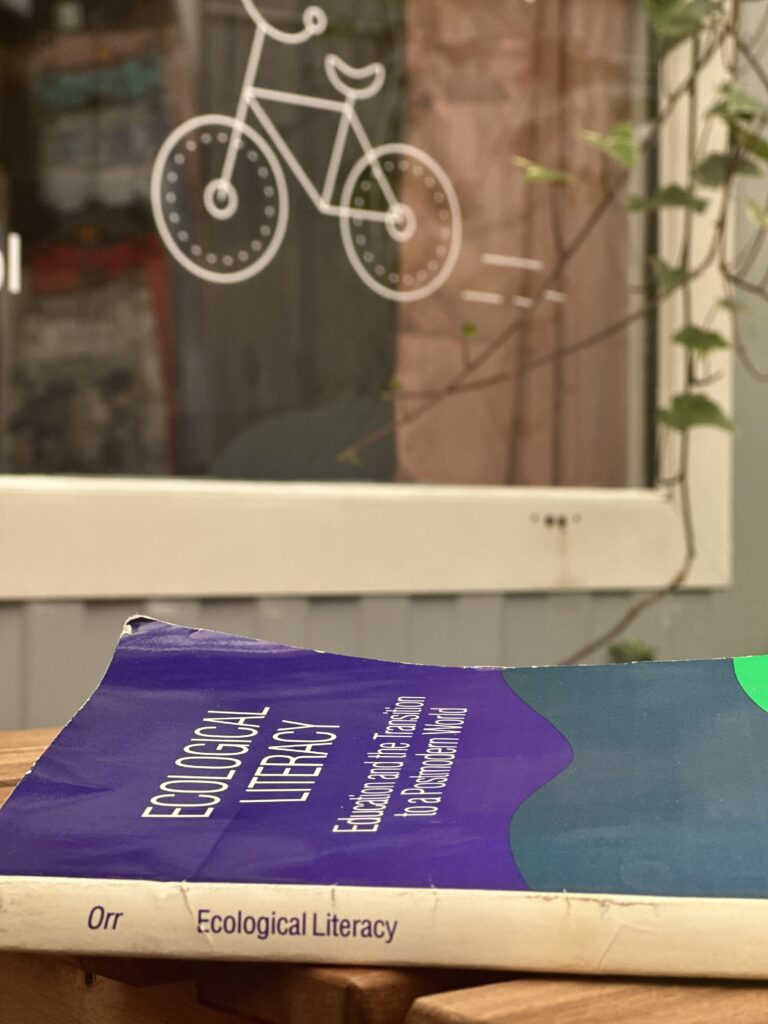
Early on in the introduction of ‘Ecological Literacy ’, the author writes that ‘Nearly all discussions about the transition to a sustainable society have to do with what governments, corporations, and individuals must do. But one thing that these have in common are people who were educated in public schools, colleges, and universities.’
The author goes on to reflect that considering the incredible environmental ‘mismanagement’ of the last century, it seems obvious what a role educational institutions play in producing ‘ecological illiterates’ and that the ecological crisis is, in fact, also a testament to a failure of education.
‘….educational institutions represent a major and largely ignored leverage point to move us toward sustainability’ the author notes.
I’m developing the ‚Sustainable Urbanism & Planetary Health’ Curriculum with the awareness that ‘sustainable urbanism’ is not simply a developer or municipal imperative but also a collective project – a humanity project, in fact. With the increasing tendency of humans globally to live in cities, it is in fact an imperative not only for ‘quality of life’ but also for the viability of urbanizing tendencies and ‘future-proofing’ those so-called urban ‘habitats’.
-Annika, Founder at Pedestrian Space