I founded Pedestrian Space with a focus on diverse issues of walkability & sustainable urban development. My research as a PhD student over the past 4 years has had the same focus.
Over time, my activities at the NGO Pedestrian Space as well as my research, have developed to focus on urban resilience broadly, of which walkability is one of many important layers.
I also happened to have founded Pedestrian Space in the first months of the COVID-19 pandemic & for a little year or so now have had an ongoing ‘Pandemic Insights’ interview series delving into how people’s relationship with community, daily mobility & neighbourhood space changed during that time & also as a project of ‘episodic memory’ exploration (link: https://pedestrianspace.org/pandemic-insights-community-mobility-space/).
With pandemic issues being increasingly a focus for my research activities and content at Pedestrian Space, my literature review and library have naturally expanded on this topic. Thanks to Wiley, I’m glad to welcome ‘Pandemic Urbanism’ to my shelves.
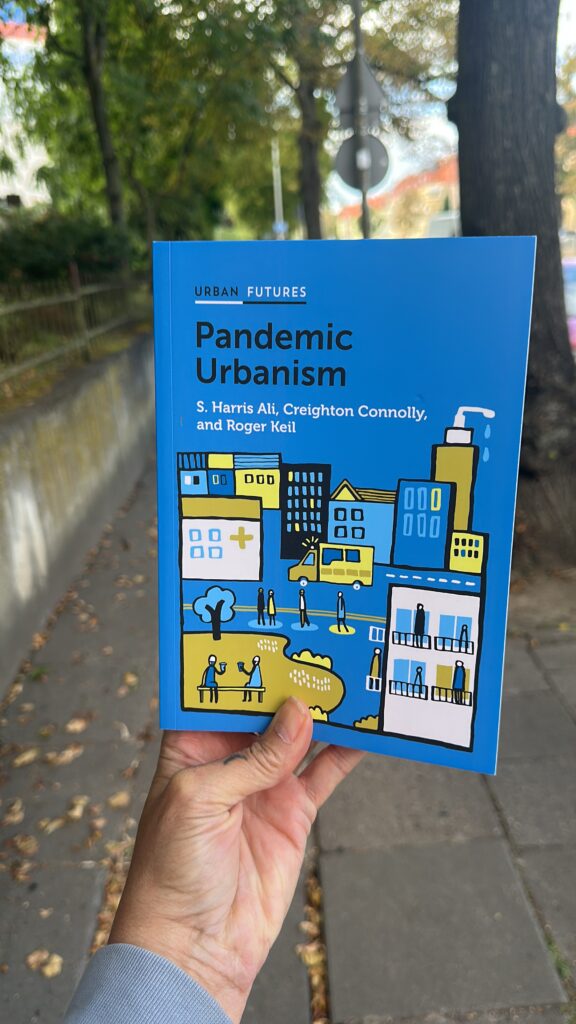
“Pandemic Urbanism: Infectious Diseases on a Planet of Cities”
By S. Harris Ali, Creighton Connolly and Roger Keil
Emerging infectious disease outbreaks have transformed the very nature of urban life worldwide, even as the extent and experience of pandemics are shaped by the planetary urban condition. Pandemic Urbanism critically investigates these relationships in a world faced with its first pandemic on a majority-urban planet.
The authors reveal the social and historical context of recent infectious disease events and how they have variously transformed the urban fabric. They highlight the important role played by socio-ecological processes associated with the global urban periphery – suburban or post-suburban zones and hinterland areas of “extended” urbanization – changing mobility patterns, and new forms of urban governance and pandemic response. The book develops novel insights for post-pandemic urban governance and planning grounded in the quest for social and spatial justice. In doing so, it reveals a paradox at the heart of pandemic urbanism: urban life enables contagion to spread easily, yet at the same time offers unique possibilities to contain and respond to disease outbreaks.
Multidisciplinary in approach and written by experts in the field, this book is an invaluable primer on the origins, pathways, and management of infectious disease.”
View more about the book at Wiley here