Fizza is a Master of Planning in Urban Development student at Toronto Metropolitan University and has been doing her academic internship at Pedestrian Space this year. Her internship project focused on researching and producing a short documentary examining projects across Toronto’s hydro greenspace corridors, with a focus on improving the design and implementation of trails, cycling infrastructure, and community gardens.
Working on Beneath the Lines has been one of the most hands-on and rewarding parts of my research experience so far.
-Fizza Qasim
Project Description: Beneath Toronto’s power lines lies an overlooked opportunity: acres of open hydro corridor land running through some of Scarborough’s most diverse neighbourhoods. This video explores how these spaces are, and aren’t, being used for food growing, recreation, and active transportation, comparing well-resourced sites like Flemingdon Community Park to underused or inaccessible stretches. Drawing on GIS mapping, field visits, and an interview with food systems expert Professor Michael Classens from the University of Toronto, this project examines who currently benefits from these spaces, where the city’s investment falls short, and what changes are needed to ensure Scarborough’s most marginalized communities gain equitable access to green space, fresh food, and safe active transportation.
Commentary and reflection by Fizza:
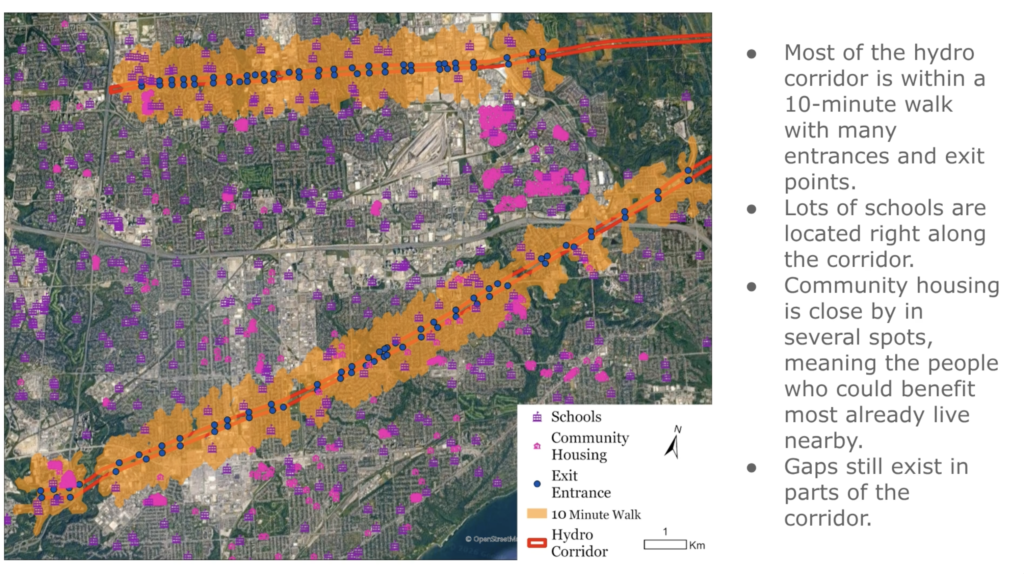
Working on Beneath the Lines has been one of the most hands-on and rewarding parts of my research experience so far. It started as a research proposal looking at food equity, green space, and active transportation across Scarborough’s hydro corridors, but it grew into a full video project with GIS spatial analysis, which meant learning a whole new set of skills alongside my planning research. I used a mix of Google Vids to plan my scenes and write scripts, and Adobe Premiere Pro for more detailed editing, helping to combine GIS maps, site visit photos, and footage into a final video. Learning these tools changed how I think about sharing research.
In planning and general academia, we’re usually trained to write papers, but this project taught me how to take the same findings- things like spatial inequities and policy gaps- and turn them into something visual that more people can actually access and understand, not just other planners or academics.
Learning these tools changed how I think about sharing research.
-Fizza Qasim
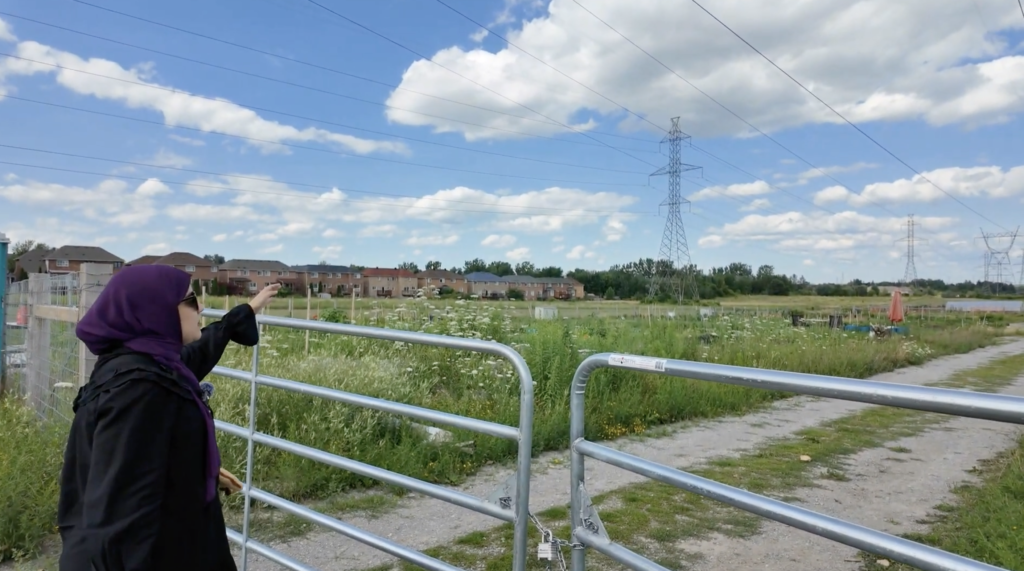
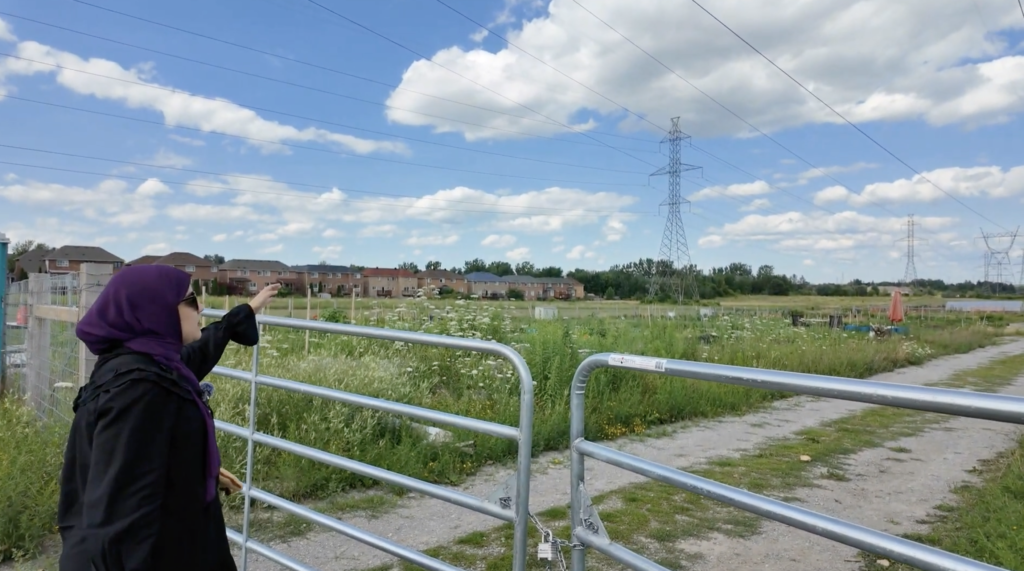
This project also taught me a lot about what fieldwork really involves. Visiting sites like Malvern and Flemingdon in person showed me things a map and reports alone could never: a locked gate with no one around to explain it, trails that were too narrow and winding, or a food garden that felt genuinely full of life, culture, and community.
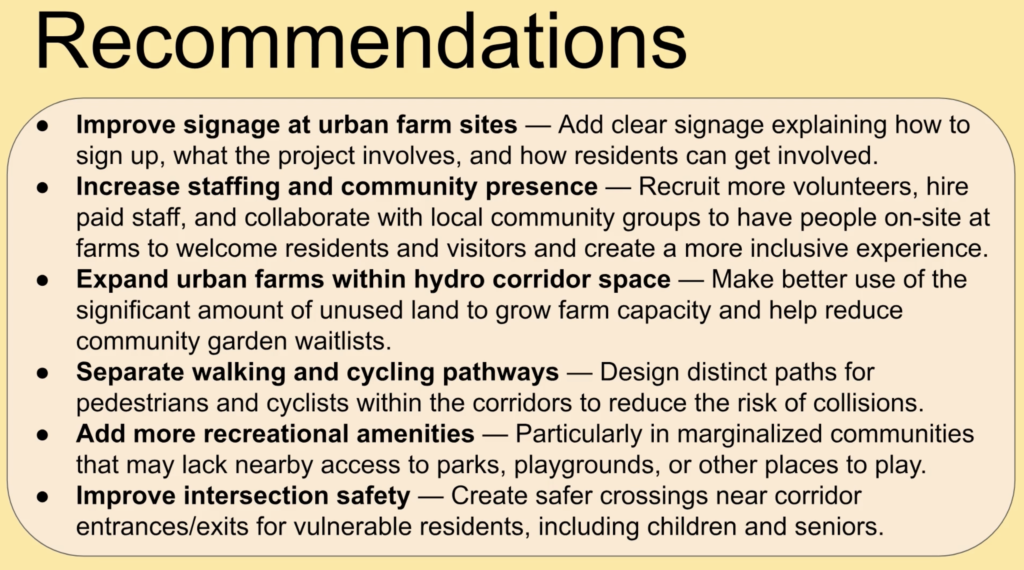
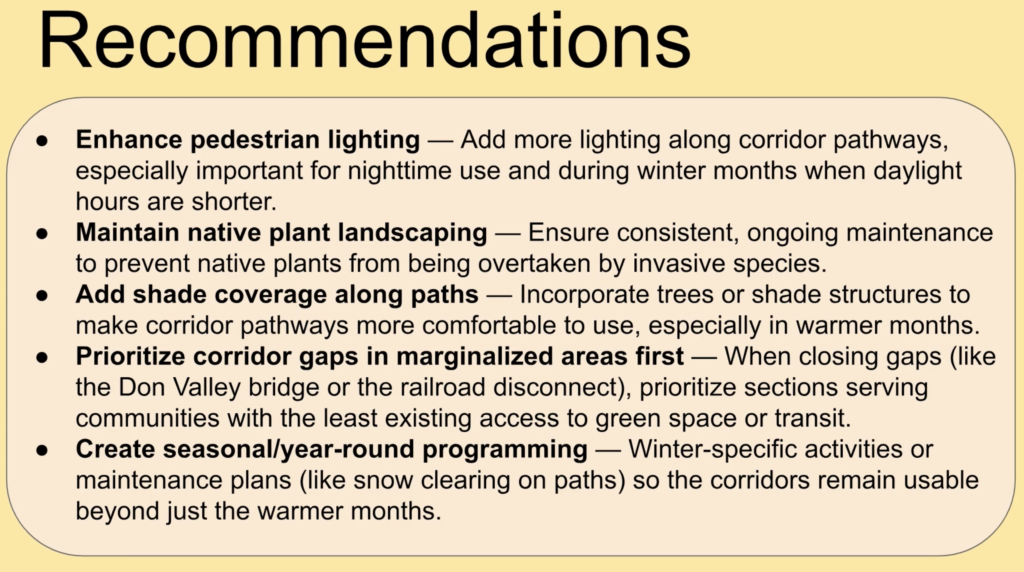
Seeing that gap between what the data showed and what was actually happening on the ground reminded me how important it is, as a planner, to combine spatial analysis and research with actually going out and seeing communities for yourself.
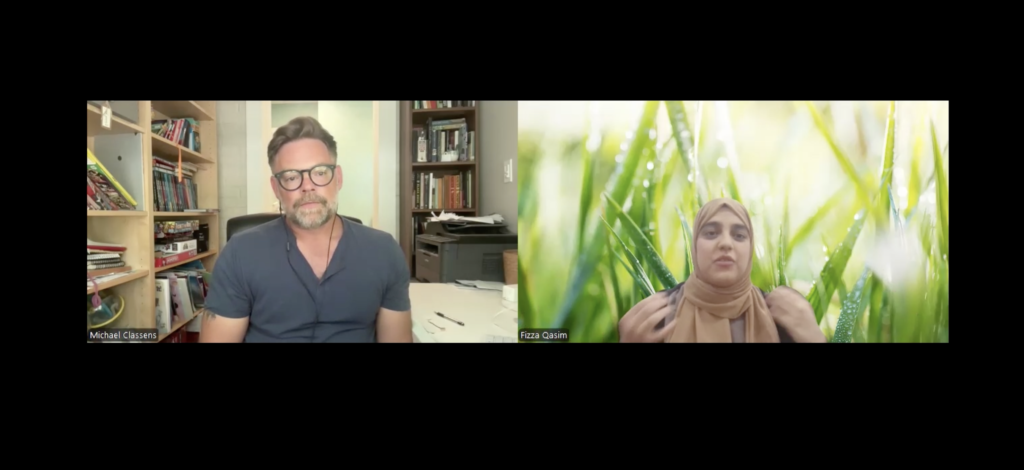
Through the interview with Professor Classens, I came to better understand that food insecurity is not an isolated issue but is shaped by land use, transportation, housing, and city policy all at once, reinforcing why planners must be well-rounded and not only learn more about the diverse issues affecting their communities but also learn how to communicate with them to actually create change on the ground.
Beyond the content, the interview itself taught me how to conduct a semi- structured conversation with an expert by learning how to ask open-ended questions and follow up on interesting threads. I think these skills, such as video storytelling, interview prep, and combining GIS work with fieldwork, will be really useful as I enter my planning career. Public engagement and communication are a big part of good planning, and this project gave me real experience creating content that’s easier for both residents and decision-makers to understand.
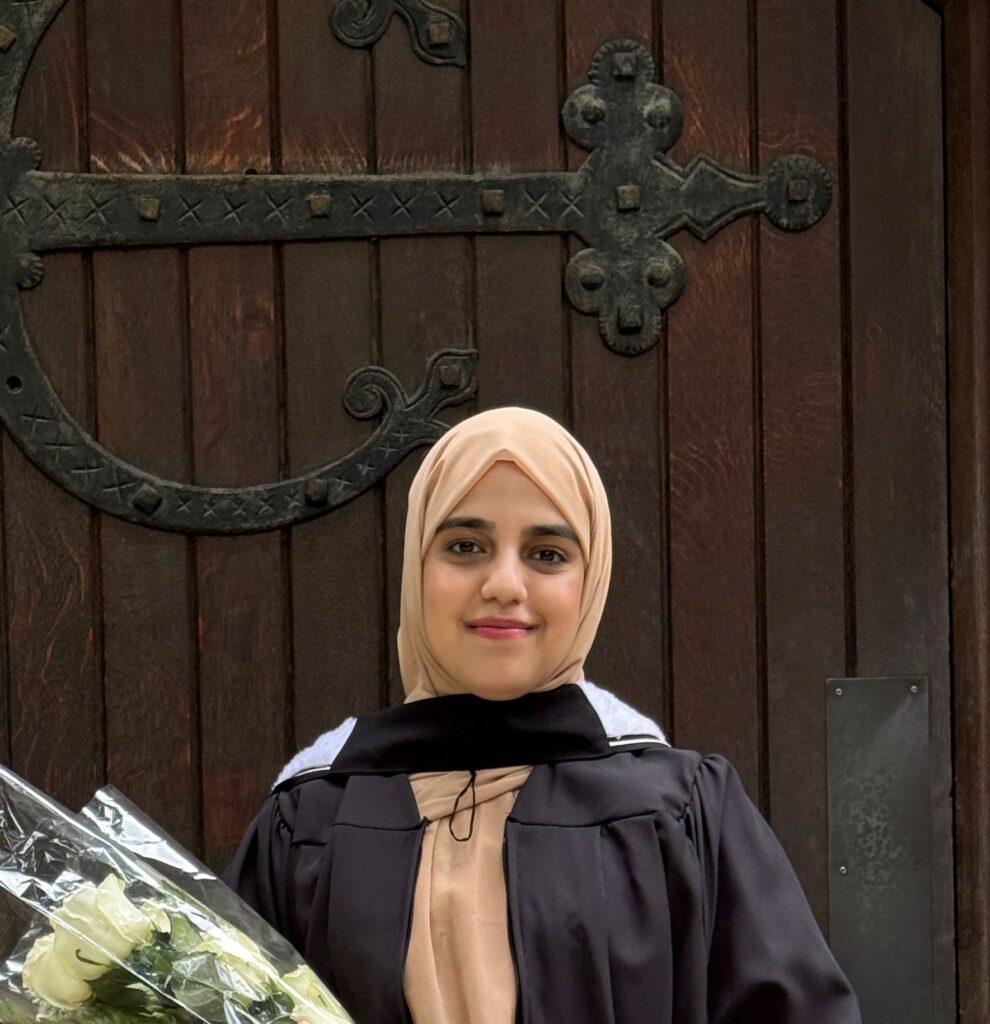
Fizza is a Master of Planning in Urban Development student at Toronto Metropolitan University. Through her academic and professional experience, Fizza has developed a strong interest in advancing environmental sustainability alongside community development. Beginning in May 2026, she will undertake an internship focused on active transportation, green spaces, and the enhancement of public spaces. During her internship with Pedestrian Space, she will research and produce a short documentary examining projects across Toronto’s hydro greenspace corridors, with a focus on improving the design and implementation of trails, cycling infrastructure, and community gardens.
Read more about Fizza’s work during her Pedestrian Space internship here: https://pedestrianspace.org/tag/fizza-qasim/
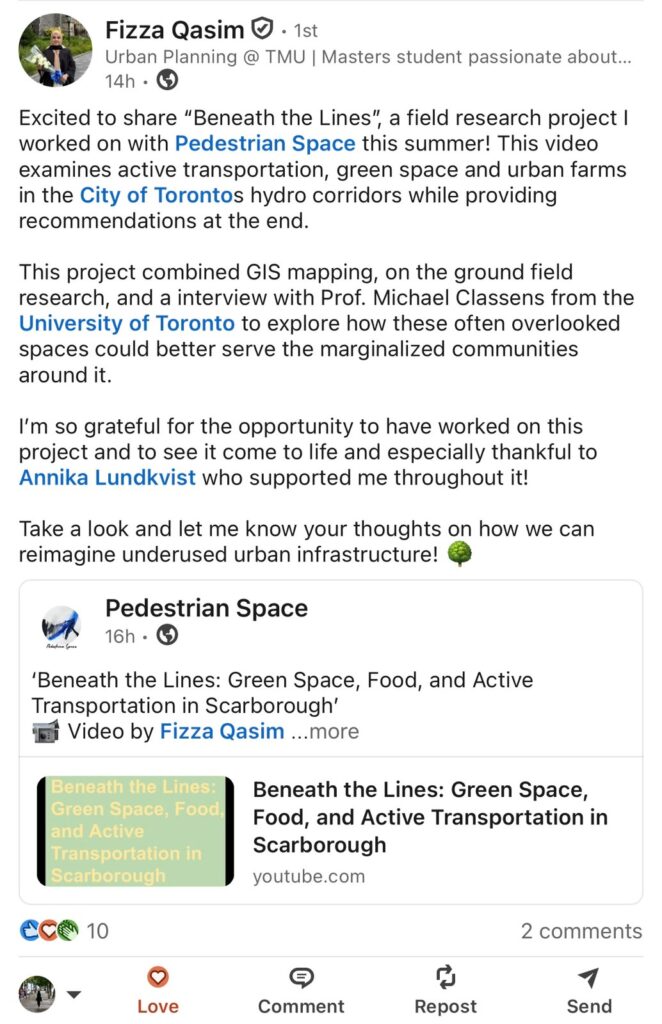
Pedestrian Space Founder’s Note: We greatly value the work that Fizza has done here. She took on a fascinating and interconnected set of themes and not only created very interesting research but also produced it in video format!
Interns and academic placements at Pedestrian Space are always encouraged to explore topics relating to urbanism and sustainability via their disciplinary lens and also with a focus on media output, which can often mean learning new skills in content creation. Fizza really achieved this beautifully!