In February 2023, we hosted an online ‘Mobility Thought Lab’ in conjunction with the NGO Living Streets Edinburgh, a workshop experience designed for local residents to discuss issues of urban mobility.
This pilot study was based on a survey conducted to engage citizens in Edinburgh, in conjunction with a remote workshop, on local best practices and barriers to walkable urbanism.
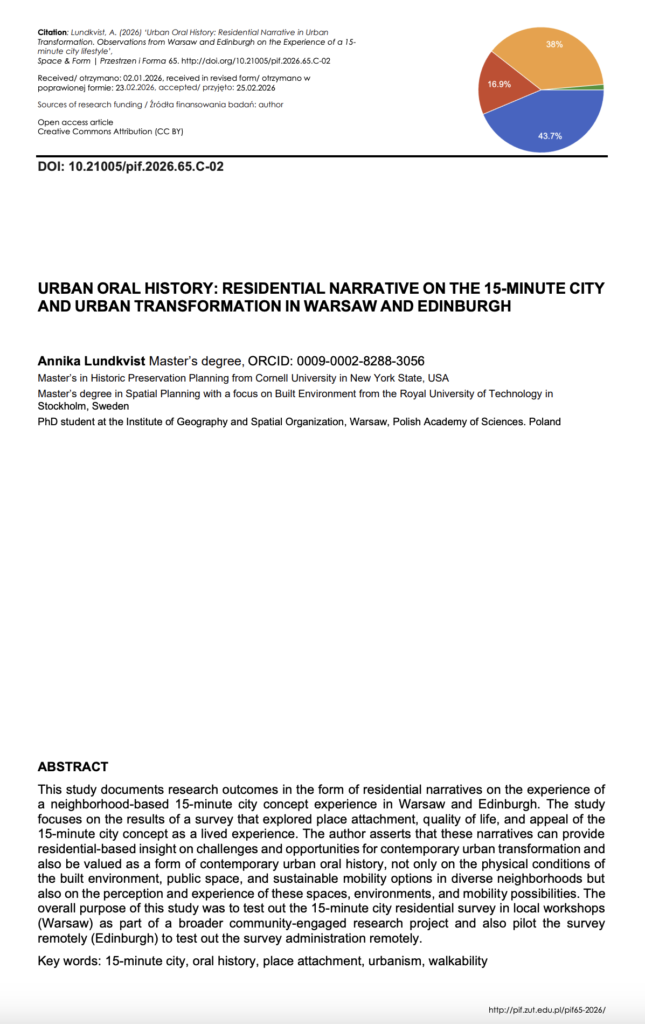
Data from this workshop, survey, and study were first published in Issue 65 of space & FORM journal, https://pif.zut.edu.pl/pif65-2026/
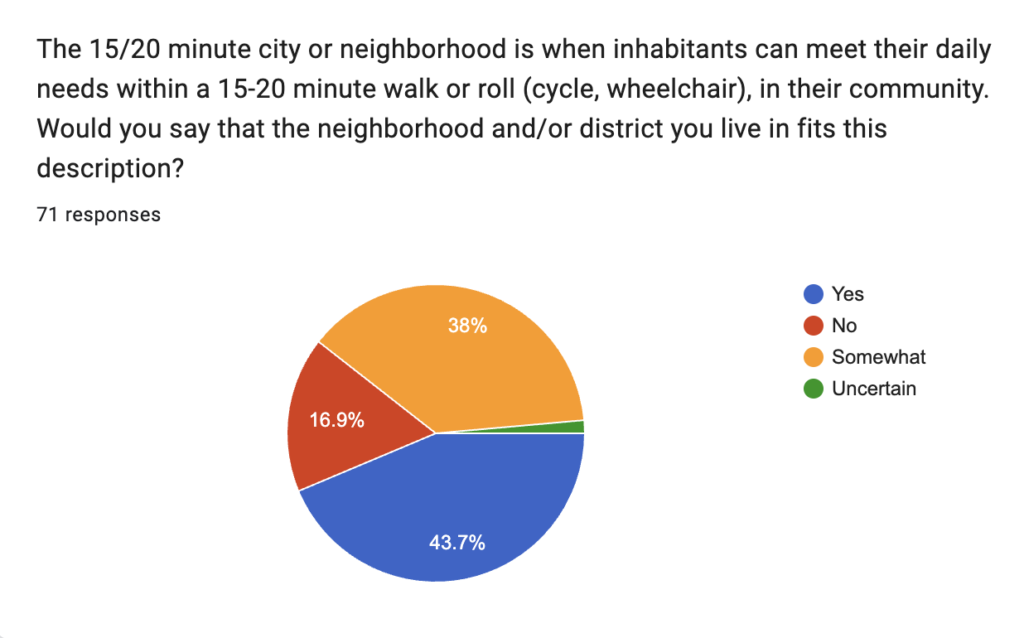
The survey, promoted with Living Streets Edinburgh, was designed as a 15-minute city residential survey that allowed for reflection and analysis of the availability of diverse amenities and services in local neighborhoods and the effects of such proximity on quality of life.
“I think I live in an ideal neighborhood. I can keep my carbon footprint low in terms of travel and stay healthy by walking to local facilities. I think it is good for the community spirit, too. I enjoy passing local people as I walk to the shops and recognise workers in shops.“
The lens of the 15-minute city serves to frame the analysis of local neighborhood life and how the perception and availability of various amenities and services, and the ability to walk or cycle for local needs, affect residents’ quality of life.
-Annika, Pedestrian Space
“Within 15 minutes on foot, I can get to a coffee shop or to a lochan inhabited by herons, a place to buy or loan a book, my best pals’ flat, my raised bed in the local community garden, and anywhere else I might need to go. I can reach the bus stop or (soon…) the tram stop.“
The study was also a means to remotely test the method that we were deploying on the ground for a study in Warsaw, Poland (above). Some preliminary comparative notes between the survey results have already been noted at the link below.
The qualitative data produced by the surveys is framed in our work as ‘residential narratives’ that offer insight into local strengths and challenges of the provision of pedestrian space and infrastructure, as well as aspects of local mobility culture.
The lens of the 15-minute city serves to frame the analysis of local neighborhood life and how the perception and availability of various amenities and services, and the ability to walk or cycle for local needs, affect residents’ quality of life.
“I feel like it helps me with my time management, and I am more productive than I would be if I had to travel a 90-minute round trip to work. Because places are so accessible, I have been able to uphold my hobbies and social lifestyle as well as work.”
“There is also the loss of retail units and pubs in recent years, replaced by apartments, making it harder to stay in the area and/or socialize; it also makes the streets feel less safe when there are fewer businesses open.“
Key residential narratives that emerged from this engagement are featured here, including:
- Prioritization of neighborhood life
- Appreciating the practicality of proximity
- Preference for sustainable mobility options
- Misconceptions and comprehension of the concept
- Understanding and prioritizing the inclusive dimension
*Note: The survey was anonymous. We collected metric data including gender, age range, education, and household status, yet for the publication of some results here online, have chosen to include only age range.
Prioritizing neighborhood life:
Diverse responses from the Edinburgh survey reflected the residents’ appreciation for the benefits of neighborhood-based lifestyles and proximity. Many of the responses also emphasize the social dimension that, for them, is part of the fabric of a vibrant, healthy, and local neighborhood lifestyle.
“When you walk, you’re more likely to interact with neighbours and others living nearby, so you feel safer and a sense of belonging.” (66 & over, Female, Edinburgh)
“I think I live in an ideal neighborhood. I can keep my carbon footprint low in terms of travel and stay healthy by walking to local facilities. I think it is good for the community spirit, too. I enjoy passing local people as I walk to the shops and recognise workers in shops.” (56-65, Female, Gilmerton Inch, Edinburgh)
“I notice more things by walking around my local area that I wouldn’t know about if I drove. I also often run into people I know, so there is a social aspect.” (26-35, Male, New Town and Broughton)
“There is a positive emotional bond elicited by seeing the same faces each day. When the majority of needs are catered for within the community, you get to know people.” (36-45, Edinburgh)
“Being able to bump into friends and neighbours and have no need for a car is important. We are a 3rd generation family here.” (66 & over, Merchiston, Edinburgh)
“I love where I live! I have quite a lot of friends who live nearby and whom I regularly bump into in the shop, in the park, or just on the street. I even know some of my neighbors by their names. If I didn’t work in the centre of the city, I likely wouldn’t spend much time outside of my neighbourhood unless I had something specific I wanted to do or visit, because I have everything I need here.” (26-35, Female, Leith Links, Edinburgh)
“I’m not attached to this place, but I like things being nearby.“
In our research, community engagement and work on proximity, urban resilience, and residential satisfaction, we are also interested in dimensions of place attachment.
When asked about proximity to diverse services and the effect on place attachment, diverse residents responded:
“It definitely increases the bond with an area and allows for the development of relationships with those providing services nearby.” (56-65, Male, Morningside, Edinburgh)
“I’m not attached to this place, but I like things being nearby.” (46-65, Male, Portobello, Edinburgh)
“The lack of availability of cultural amenities locally definitely reduces my attachment to the area I live in.” (56-65, Male, Edinburgh)
“I do feel a bit isolated because I need to cycle to access most facilities. Where I lived before (Easter Road), we had more facilities on the doorstep, and I felt more attached to that place.” (36-45, Female, Northfield and Willowbrae, Edinburgh)
“I am very attached to where I live, and the accessibility of local features is a major part of that.” (26-35, Male, Grange Prestonfield, Edinburgh)
“It doesn’t (affect place attachment), as such. But it is convenient.” (66 & over, Stockbridge and Inverleith)
“Having Holyrood Park literally on my doorstep is amazing. I can go from my flat to actually being in the park within a minute, which is only possible for a tiny proportion of Edinburgh’s residents.”
-Edinburgh 15-minute city survey respondent
At Pedestrian Space, we are very engaged with the topic of biophilic urbanism and the role of nature in cities for enhanced walkability, human health (mental, emotional, physical) as well as the role of nature supporting biodiversity in cities.
Residential narratives from the 15-minute Edinburgh survey included references to the proximity of parks and green spaces and their impact on health.
“Balgreen (Murrayfield/Corstorphine) has all of these factors and yet remains like a small village because of its geographical location. We are very lucky to have such an abundance of green spaces, amazing public transport links, and a choice of shops nearby. Our emotional attachment to the area is strong enough to have encouraged several family members to move into the area over the decades.” (46-55, Male, Corstorphine, Edinburgh)
“We have insufficient green space east of Broughton, which has an impact on mental health and happiness.” (56-65, Female, New Town and Broughton, Edinburgh)
“Lochend Park is a real haven for wildlife and an undersung gem of a green space! There are also multiple community gardens within a 15 minute walk.”
“It’s great to have so much green space near me. I often walk/run outside, which is great for my mental health.” (56-65, Female, Fairmilehead, Edinburgh)
“Having Holyrood Park literally on my doorstep is amazing. I can go from my flat to actually being in the park within a minute, which is only possible for a tiny proportion of Edinburgh’s residents.” (26-35, Male, Craigentinny Meadowbank, Edinburgh)
Appreciating the practicalities of proximity
The narrative output from the Edinburgh survey also reflected perceptions on the practical benefits of proximity.
“It (proximity) was one of the major reasons for my choice of location. It massively improves my quality of life.” (26-35, Male, Grange Prestonfield, Edinburgh)
“It is nice to walk to places without needing a car. It’s very helpful having all I need close to me.” (26-35, Male, Resident of Edinburgh)
“It’s great to have everything so close to home.” (46-55, Male, Resident of Portobello, Edinburgh)
“It’s great! I don’t need a car, which is cheaper and better for the environment. I have way more time on my hands, and things are just way more accessible.” (18-25, Westend, Edinburgh)
“Everything is close enough that doing things isn’t burdensome, for example, the doctors. You can always do several things in one trip, after work, for example. I own a car but only use it for long journeys or to leave the city.” (26-35, Male, Leith Links)
“It (access to diverse amenities) was one of the major reasons for my choice of location. It has significantly improved my quality of life. I am very attached to where I live, and the accessibility of local features is a major part of that.” (26-35, Male, Resident of Grange Prestonfield, Edinburgh)
“I do not drive, but I do not need to, and the fact that it’s realistic for me to walk to everything I need encourages me to do so, which means I stay active and get to go outside! I have a choice of at least four different supermarkets within walking distance. Within 15 minutes on foot, I can get to a coffee shop or to a lochan inhabited by herons, a place to buy or loan a book, my best pals’ flat, my raised bed in the local community garden, and anywhere else I might need to go. I can reach the bus stop or (soon…) the tram stop. I can also take my cats to the vet with minimum hassle because it is also within walking distance. The degree of spontaneity I’m able to have in day-to-day life just wouldn’t be possible in e.g. the suburbs in the Midlands where I grew up, where my mum had to drive me and my brother everywhere.” (26-35, Female, Resident of Leith Links, Edinburgh)
“It’s very helpful having all I need close to me.” (26-35, Male, Edinburgh)
“I feel like it helps me with my time management, and I am more productive than I would be if I had to travel a 90-minute round trip to work. Because places are so accessible, I have been able to uphold my hobbies and social lifestyle as well as work.” (18-25, Female, West End, Edinburgh)
“Having local facilities makes life much easier and more enjoyable.” (56-65, Male, Morningside)
“Being able to bump into friends and neighbours and have no need for a car is important. We are a 3rd generation family here.”
“I like to stay active and enjoy the outdoors. I can walk to Leith Victoria. I often walk along the railway path to the Links and on to Tesco; I’m also not far from the Water of Leith. Lochend Park is a real haven for wildlife and an undersung gem of a green space! There are also multiple community gardens within a 15-minute walk. For buying groceries, I am within walking distance from Tesco, Sainsbury’s, multiple Lidls, and Aldi. I have two places of work, one is a circa 40-minute walk to the office, though I often work from home. The other one is 8 minutes, so I’m counting this as a win!
There is a bus stop right outside my door (although they changed the routes recently) and within a 5-minute walk, links to multiple bus routes, plus trams one day. For community engagement, there is a community bookshop, community gardens, and two branches of Living Rent. For sharing and reusing, there are lots of charity shops very close by, and the Edinburgh tool library is a 10-minute walk away. For taking care of your health, my GP is less than 10 minutes away, and there are at least three pharmacies, and lots of dentists (although none taking NHS at the moment of course…). (26-35, Female, Leith Links, Edinburgh)
Conversely, some respondents reflected on how the lack of proximity to diverse services negatively affected their quality of life.
“There are no outdoor or indoor public spaces except for the library, so few opportunities to see neighbours – the parks are a long way away, and the main road has too much traffic.” (26-35, Female, Grange Prestonfield, Edinburgh)
“The lack of good places to congregate, such as nearby cafes or restaurants, makes it harder to meet people without using a car. I would probably prefer to move rather than stay in this area. Yes, for daily needs, I think this (15-minute city concept) is essential, people expect it now, they are demanding a better quality of life, work/life balance, etc.” (26-35, Female, Resident of Liberton and District, Edinburgh)
“The lack of availability of cultural amenities locally definitely reduces my attachment to the area I live in.”
“There is a lack of a sizeable and reasonably priced supermarket in the neighbourhood. Other than that, my quality of life is good.” (26-35, Male, Morningside, Edinburgh)
“It would be good to have more facilities near me. The local Secondary school is almost 3 miles away. There are limited shops too.” (56-65, Female, Fairmilehead, Edinburgh)
“I think being able to reach the services you require without having to figure out complicated support networks sounds very appealing. For example, my specialist hospital is St John’s in Livingston, but it’s a nightmare to get to by public transport. Imagine if we had an integrated public transport system that enabled people with mobility issues to access health facilities.” (56-65, Female, New Town and Broughton, Edinburgh)
“Little work opportunities mean a 2-hour commute every day, which significantly affects energy levels. There is also the loss of retail units and pubs in recent years, replaced by apartments, making it harder to stay in the area and/or socialize; it also makes the streets feel less safe when there are fewer businesses open.” (36-45, Edinburgh)
“It’s great to have so much green space near me. I often walk/run outside, which is great for my mental health.”
One respondent below details specifically what is lacking, with a thoughtful reflection of how improved proximity to certain amenities, if not sacrificing local environmental features, could be a benefit.
“I do feel attached to where we live, and I like this part of town best. I sometimes wish I lived closer to cultural events, restaurants and work as all three feel like they happen ‘over there’ and not ‘here’, and I think having more of those nearby, if it doesn’t come at the expense of what we do have (as in: doesn’t mean shaving down all the trees and building over parks), would make the area more attractive and relaxing to live in.” (18-25, Female, Grange Prestonfield, Edinburgh)
Preference for sustainable mobility options
The following residential narratives offer a window into the perspectives of residents who value opportunities to walk, cycle, and take public transportation for daily activities.
“It is great to have a primary school within the area, which meant that I could walk my daughters to school. It’s also good to have the GP practice. I like to walk to keep fit and healthy.” (56-65, Female, Fairmilehead, Edinburgh)
“Everything is close enough that doing anything is not burdensome, for example, the doctors. You can always do several things in one trip, such as after work. You can own a car but only need to use it for long journeys or to leave the city.” (26-35, Male, Leith Links, Edinburgh)
“Pleasant place to live, but would like a safer way to walk / roll.” (46-55, Male, Portobello, Edinburgh)
“My quality of life is substantially improved by walkable access to most amenities.” (Edinburgh)
“I live here because I can easily walk/cycle within 10 minutes to access everything I need!” (35-45, Edinburgh)
“It’s great. I love walking everywhere, and being able to shop day to day.” (66 and over, Female, New Town and Broughton, Edinburgh)
“Saves me time, saves me money as I don’t have to own a car, free exercise from walking between places.” (Male, 26-35, Resident of New Town and Broughton, Edinburgh)
“Although I have a car, I usually walk or use public transport most days rather than drive.” (66 and over, Female, Edinburgh)
Conversely, some survey respondents detailed how the lack of ability to walk or cycle is detrimental and how environmental conditions, such as pollution, are barriers to doing so.
“I do need to have all of the above easily accessible, as I don’t drive. I really wish more of these were within a 10-15-minute walk, as cycling can feel dangerous in my area, and I know that many people don’t feel confident enough to cycle on the road.” (36-45, Female, Northfield and Willowbrae)
“The local infrastructure is largely optimised for cars, so my safety as a pedestrian and cyclist is always second priority.” (36-45, Female, Edinburgh)
“It (proximity) is essential; the local opposition to things like segregated cycling infrastructure (or any cycling infrastructure) makes me feel disconnected from the people living in the area.” (36-45, Male, Silverknowes, Edinburgh)
“It’s (access to diverse amenities) helpful and welcome, but unfortunately mitigated by the fumes and noise of heavy road traffic through the centre of Stockbridge.” (66 and over, Stockbridge and Inverleith, Edinburgh)
Yes, it makes sense to live somewhere where stuff is close at hand, and you can build connections with neighbours etc.
“We have lost some of these functions in recent years. Plus, the frequency of buses has been reduced.” (56-65, Female, Liberton and District, Edinburgh)
“It’s a longer journey to school due to large roads that prioritise vehicular traffic, preventing active travel journeys. There is no way to walk kids to the park or playground as too far or too traffic-y.” (26-35, Female, Grange Prestonfield, Edinburgh)
“I can just about reach some facilities by walking 20 to 25 minutes (I am 75 years old ), but alongside heavy traffic and very polluted air. This area was a small village surrounded by green fields several years ago. It is now a heavily developed urban area with heavy traffic congestion. Many original homes now directly open onto the polluted roads. This (15-minute city concept) sounds very appealing as this area has deteriorated so much that it is a health hazard to walk anywhere here. There are too many journeys by car.” (66 and over, Female, Resident of Edinburgh)
“It keeps me healthy by having to walk around, and it makes for an interesting and enjoyable place to live; however, there are some problems with the area, too. The streets are very car-dominated and noisy, which can discourage walking. I would cycle, but it’s too dangerous.” (18-25, Male, Tollcross, Edinburgh)
“The accessibility and availability of (different) amenities make me value my area. However, the area is still dominated by road traffic (London Road especially), and functions centered around road transport and parking make the neighbourhood feel like a thoroughfare rather than a place for people.” (26-35, Male, Craigentinny Meadowbank, Edinburgh)
Misconceptions and comprehension of the concept
Lack of trust, suspicion, and paranoia about the concept also appeared in select responses. A misunderstanding about the 15-minute city concept appeared in select responses, when respondents misinterpret it to mean limiting their movement, rather than simply having diverse amenities available locally. These types of sentiments are where we also view community-engaged approaches as essential to help shape awareness and mitigate misunderstandings, fear, and suspicion.
“It’s nice to have them (amenities) available close by, but I am very happy to go further to increase my choice and widen my horizons. I choose to live in a City, not a village.” (56-65, Female, Edinburgh)
“It affects me greatly. I do not agree that we should be trapped and monitored like cattle. We are human beings who should have freedom of movement without fear of an authoritarian regime dictating our next move. I do not agree that this should be implemented to any degree, and I will use every opportunity to express this. None of us in this community has been consulted and I expect that we will be reached out to to discuss this. All I can say is how dare you even consider bringing this to the people after what we have all suffered.” (18-25, Female, Tollcross, Edinburgh)
“Not at all. It’s creating barriers and reducing connectivity, and reinforcing a reservationist mentality where you can move about freely.” (46-55, Male, Craiglockhart, Edinburgh)
“The area is very desirable to live in, but I don’t see why the movement to other areas of the city or elsewhere should be restricted because of this. It sounds like an open-air prison. If we are not allowed to leave a 15/20 minute neighbourhood, how can we get to work, visit friends and relatives, and so on?” (26-35, Male, Morningside, Edinburgh)
“I enjoy the freedom to choose where to educate my kids, where to shop, and where to work. I do not want to be constrained. It feels as though my choice is being restricted. The concept suits middle-aged men, not busy working mums. We need to be in 10 places at different times every day. We want the best for our kids and should not be limited in our freedom to choose.” (36-45, Female, Colinton, Edinburgh)
“Not really. It’s a big city out there, with lots to see and do. The idea that people want to stick to within 15 minutes of their home is ludicrous.” (56-65, Edinburgh)
Conversely, when asked if the 15-minute city concept sounded appealing (whether the person had this lifestyle or not), some residents had practical and positive reflections:
“Yes, for daily needs, I think this is essential, people expect it now, they are demanding a better quality of life, work/life balance etc.” (26-35, Female, Liberton and District)
“The term feels super appealing to me, as I believe cities should be built in a way that gives people easy access to everything they need, without making them dependent on cars.” (36-45, Female, Northfield and Willowbrae)
“If it were implemented properly, yes.” (36-45, Female, Edinburgh)
“I think being able to reach the services you require without having to figure out complicated support networks sounds very appealing. For example, my specialist hospital is St John’s in Livingston, but it’s a nightmare to get to by public transport. Imagine if we had an integrated public transport system that enabled people with mobility issues to access health facilities.” (56-65, Female, New Town and Broughton, Edinburgh)
“I do (see it as appealing). I have lived in these areas in 3 different countries over the last 20 years, and it’s a huge part of my quality of life.” (56-65, Male, Leith Harbour and Newhaven, Edinburgh)
“Yes, for daily needs, I think this (15-minute city concept) is essential, people expect it now, they are demanding a better quality of life, work/life balance, etc.”
“Yes, it makes sense to live somewhere where stuff is close at hand, and you can build connections with neighbours etc.” (26-35, Female, Grange Prestonfield, Edinburgh)
“This sounds very appealing. As this area has deteriorated so much, it is a health hazard to walk anywhere here. So, too many journeys are by car. Even the buses, which are frequent now, stop far too close to the original residents’ front door,s so they have a loss of privacy plus much littering and noise.” (66 and over, Female, Edinburgh)
“It definitely sounds appealing. I’m hoping for more shops locally, and a shift away from car-centric design.” (26-35, Male, Craigentinny Meadowbank, Edinburgh)
“Clearly, it’s better to have access than not.” (36-45, Male, Colinton, Edinburgh)
“It is very appealing. I do cycle, which extends my reach a bit, but I would love to easily be able to walk to a variety of shops (rather than just one). And a cafe and/or pub would be awesome!” (36-45, Female, Edinburgh)
“It’s great to have everything so close to home.”
Understanding and prioritizing the inclusive dimension
Urban mobility can be complex, with residents using multiple modes of transportation per day. An inclusive approach also considers that even many car-dependent individuals are often looking for walkable features in their own environment for diverse reasons.
Inclusivity can be understood and interpreted in several different ways. In terms of enhancing walkability locally, an inclusive planning approach focused on walkability would consider the needs of people walking with different disabilities, walkers, strollers, people in wheelchairs, and other needs. It also considers elderly residents who, for diverse reasons, may live a very localized life.
Additionally, such an approach can consider that some individuals cannot or do not want to drive or simply do not own a car, as conveyed in some of the responses from Warsaw and Edinburgh.
“Being older, it is nice to have everything nearby. I find central Edinburgh far too busy with cars. It’s great to have everything so close to home.” (66 and over, Female, Corstorphine, Edinburgh)
“It is nice to walk to places without needing a car. It’s very helpful having all I need close to me.”
“We have children and Edinburgh is awful for parking a car, so having good accessibility/availability locally is crucial.” (36-45, Male, Silverknowes, Edinburgh)
Finally, the importance of proximity to local amenities for people with diverse disabilities that can affect their mobility is enormous. This is an area deserving of considerably more attention, public awareness building, and research in the scope of local urbanism and 15-minute city.
“Don’t need to spend time and money getting in a car. I support a gentleman in a wheelchair with an adapted car. If everything was within a 15-minute cycle, we could just use an adapted bike.” (46-55, Male, Resident of Edinburgh)
“It’s (having diverse amenities locally) helpful in winter when yearly I have to shield because of Immuno Suppression and other disabilities.” (56-65, Female, Portobello, Edinburgh)
“I am very attached to where I live, and the accessibility of local features is a major part of that.”
The value of community-engaged research for proximity and quality of life studies
The survey and remote workshop for this work aimed to engage locals in Edinburgh to reflect on their urban mobility options and decisions, as well as how proximity to different services and amenities affects their quality of life and place attachment.
The qualitative data produced by the surveys is framed in our work as ‘residential narratives’ that offer insight into local strengths and challenges of the provision of pedestrian space and infrastructure, as well as aspects of local mobility culture.
The results focused on prioritizing the neighborhood context, potential for enhanced quality of life with proximity to diverse amenities, the role of social connectivity and community creation related to such proximity, and valuing the opportunity for regular pedestrians and cycle mobility.
This research first appeared in the paper Urban oral history: residential narrative on the 15-minute city and urban transformation in Warsaw and Edinburgh in Issue 65 of space & FORM journal. Access here: https://pif.zut.edu.pl/pif65-2026/