Urban Design from India to Michigan
April 22, 2026
I recently got a message from Pruthvi Shah, an urban and architectural designer specializing in climate-resilient public spaces. Originally from India, she is now based in Michigan, where she recently finished her Master’s degree from the University of Michigan. She wrote to me on LinkedIn as she came across my work on urban resilience and was also interested in my research on 15-minute cities, walkability, public space, and urban health. She noted that my focus on community-engaged research also really resonated with her.
She reflected that she is looking to move more into research-focused work, especially around community empowerment, accessibility through transport, and ecological resilience, and was also interested in collaborating. She had also seen my posts on the Pedestrian Space ‘Sustainable Urbanism & Planetary Health‘ curriculum that I am developing and noted that she was very moved by how thoughtfully I am developing the curriculum.
She noted that she had ideas for collaborating on background research on ‘how small, human-centered changes in cities can have a big impact on community well-being, accessibility, and long-term sustainability’ and research that combines urban systems, equity, and education.
She also noted wanting to support research and work on accessibility and mobility in everyday urban life, particularly how public transportation infrastructure can better serve diverse communities, using case studies on walkability and community participation.
“Because the curriculum is designed to ‘come alive’ in local contexts,” she wrote, “I hope to engage in research on how different regions apply sustainable urbanism frameworks to educational settings.“
Yesterday at 18.00 in my region, we had our first virtual talk. It had been a long day for me. I currently work with primary school children every day while also tending to my PhD duties and research work. The curriculum I am designing is, in fact, a way to connect my roles and different siloes. I share about it not only to ‘spread the word’ but also explicitly to invite exactly the types of collaboration that Pruthvi approached me about.
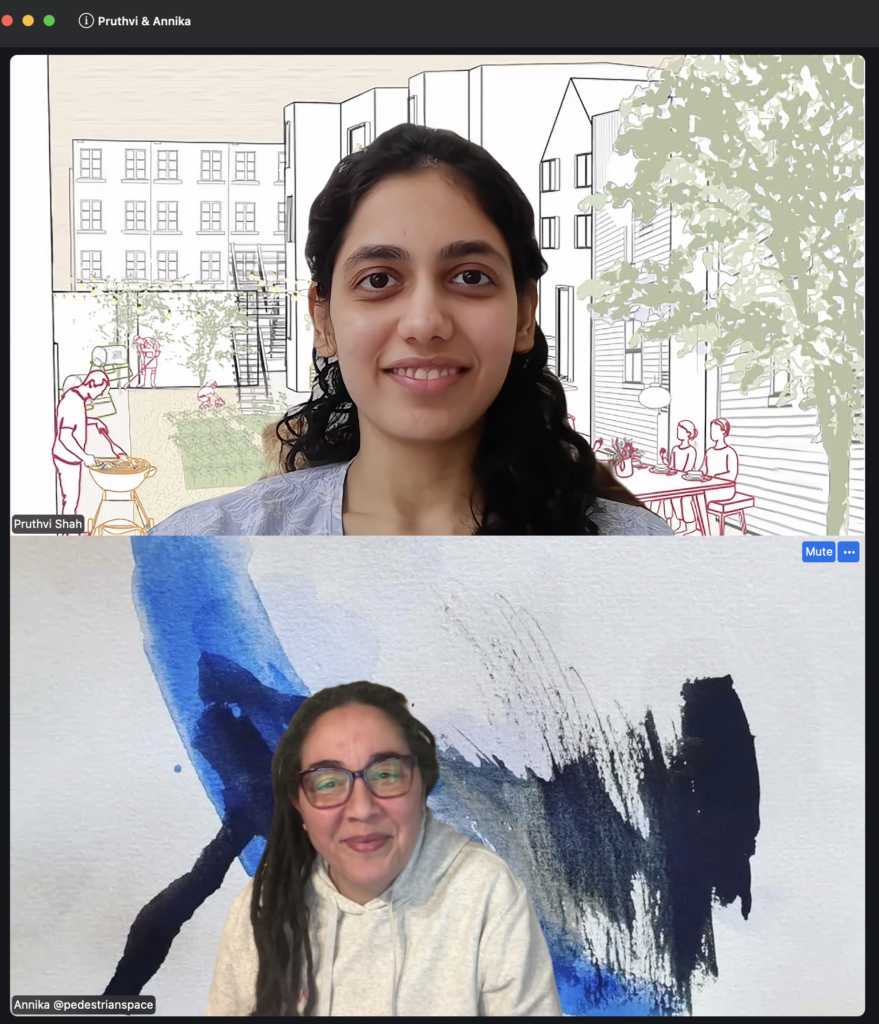
As we talked yesterday evening, my weariness from a long day dripped away. I felt a bubbling of excitement, ideas, synchronicity, and inspiration. Pruthvi shared her portfolio with me, with projects spanning Boston, a mountain town in France, Detroit, and more, and thematically also hooking my interest with topics such as urban heat, public space, food insecurity, heritage, and resilience being addressed.
I felt inspired as well as thankful for her proactive reaching out, as well as her incredibly thoughtful communication.
The conversation also had me thinking about the value of collaborations with different individuals and disciplines, whose insights can help the creation of an even more dynamic curriculum, which I am developing as a ‘global and public resource’.
Imagine such a curriculum where children from all over the world can ‘see themselves’ in some way, as the content includes contributions from passionate experts from all over the world.
“Because the curriculum is designed to ‘come alive’ in local contexts,I hope to engage in research on how different regions apply sustainable urbanism frameworks to educational settings.”
-Pruthvi Shah
Pruthvi spoke about how much she enjoys communicating design language to people outside her discipline and also emphasized how much she appreciates awareness-building, which is also a central interest of mine as the founder of an NGO focused on communications and advocacy, as an educator, and as a researcher.
I view this curriculum as a project that I will carry through my life- not a product to design and finish but a living path to experiment on, navigate, develop, and serve. The curriculum is also a connector. I deeply value Pruthvi taking the time to reach out as well as her sincerity and passion to contribute her own disciplinary expertise and wisdom.
Pruthvi, I look forward to collaborating with you!
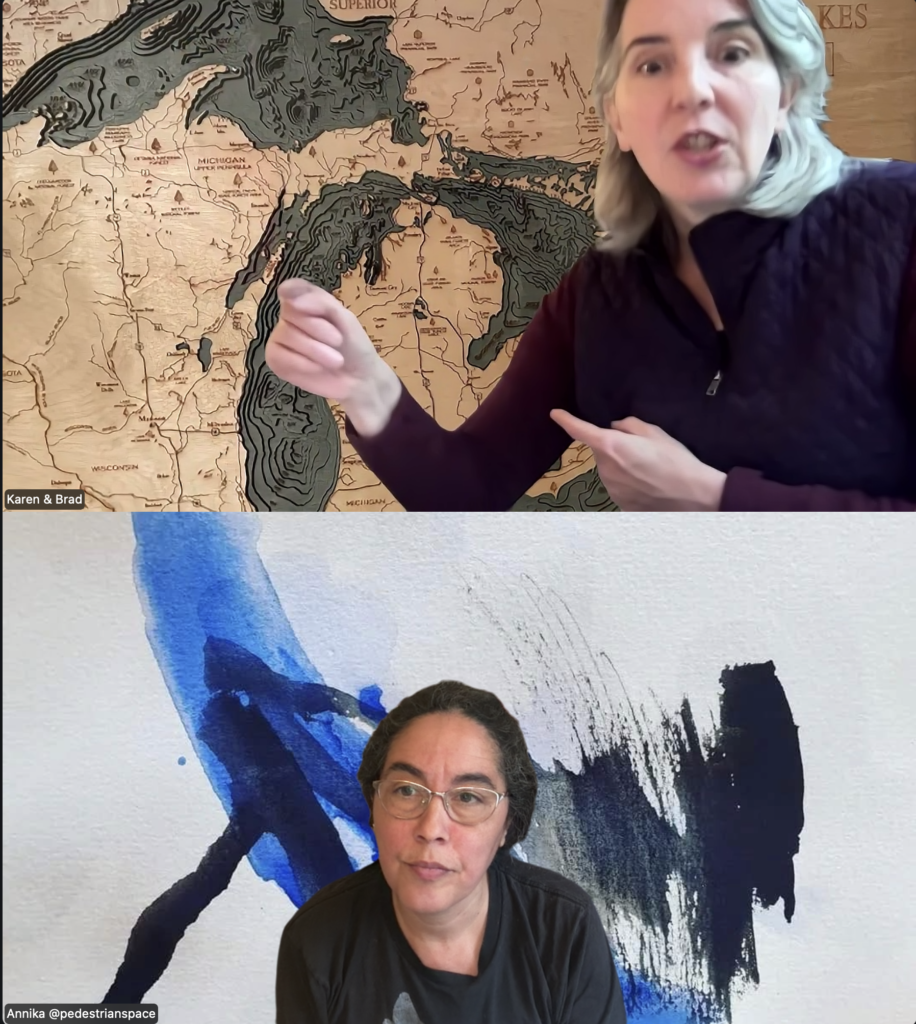
Great Lakes Dialogues
May 24, 2026
I’ve always enjoyed networking. Since I’ve begun sharing about the Pedestrian Space ‘Sustainable Urbanism & Planetary Health’ Curriculum that I’m developing, I’ve really enjoyed people reaching out with interest to share about similar things they are doing or to participate, and even to offer help with the curriculum!
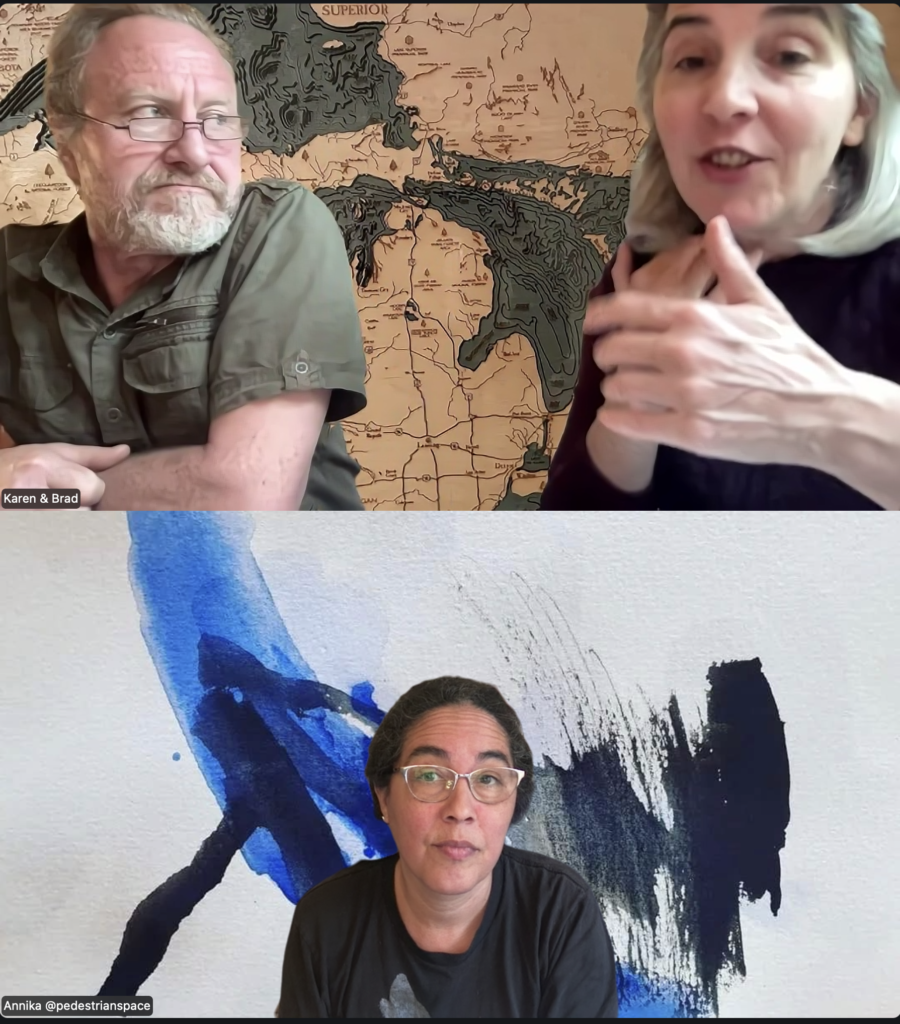
Dr Karen Lemke, PDC, and I had our first chat last month after connecting here. Last weekend we met again, along with her friend Brad, also based in Wisconsin. It was a New Moon weekend, and they started off by sharing about a ‘Dark Sky Park’ walk they had gone on the prior night, learning and talking about light pollution and its effect on bird migration and other species. They reflected on how fireflies were active (a month earlier than usual) as well as the fact that it was 85 Fahrenheit (about 29 Celsius)- typical for July but not May. We spoke about the various movements and influences of humans on wildlife and approaches to mitigate that.
We also got into the topic of water. I have to confess that I wasn’t aware how much coast there was in the Great Lakes and that its referred to as the ‘Fresh Coast’ or ‘Third Coast’ (more lake-shore circumference than the United States West and East Coast combined).
Karen reflected on water as a place-based resource, and we began to get into issues of water scarcity in regions globally. Karen and Brad shared about the ‘Great Lake Compact’, an agreement between the U.S. states of Illinois, Indiana, Michigan, Minnesota, New York, Ohio, Pennsylvania, and Wisconsin, which bans the diversion of Great Lakes water outside the basin.
We touched on the ‘ecological realities’ of water and the current as well as upcoming challenges of water for communities.
Grateful for thoughtful connections made!