Earlier this year, I began developing the Pedestrian Space ‘Sustainable Urbanism & Planetary Health’ curriculum. At the heart of the curriculum are five thematic modules that shape the place-based, creative, and educational approach of the program.
Later this year, we will be piloting one activity module in the curriculum as well!
The pilot will be focused on the intersection of two of the five curriculum module themes: Mobility and Community. The pilot is also focused on the topic of Urban Heat, via the intersecting lens of the themes of Public Space, Built Environment, and Nature.
I’m the founder of the NGO Pedestrian Space and an urban researcher. Having worked in diverse educational settings, as well as with students of all ages and diverse ‘special needs’, I bring a passion for engaging youth and connecting that engagement to my passion for issues of sustainable urbanism. I will be piloting in Szczecin, Poland.
With experience, via the community engagement and NGO activities of Pedestrian Space, I also integrate the cultivation of a global network of educators, researchers, and community organizers who are interested in working with the curriculum.
A pilot in Bengaluru, India, will be led by Diana Sushmitha, an assistant professor who has specialized in cafe culture in the city. Her interest in this has led to her involvement in how education can link Ooru (Bengaluru) and the world, being rooted in the local and still belonging to the world at large.
A pilot in Tehran, Iran, will be led by Hajar Almasimashak (Naaz), who leads community-based environmental education initiatives for and with children through participatory and arts-based methods, such as the ‘Our Green Neighborhood Initiative,’ which focuses on children, sustainability, and public space.
A pilot in Västerås, Sweden, will be led by Siriphan Liyawarakhun, an international educator working as an MYP Individuals and Societies teacher and Community Project Coordinator at Mälardalen International School, and interested in integrating themes of Sustainable Urbanism and Planetary Health into classroom learning units to strengthen inquiry-driven community-based learning and support students in connecting their local experiences with broader global perspectives.
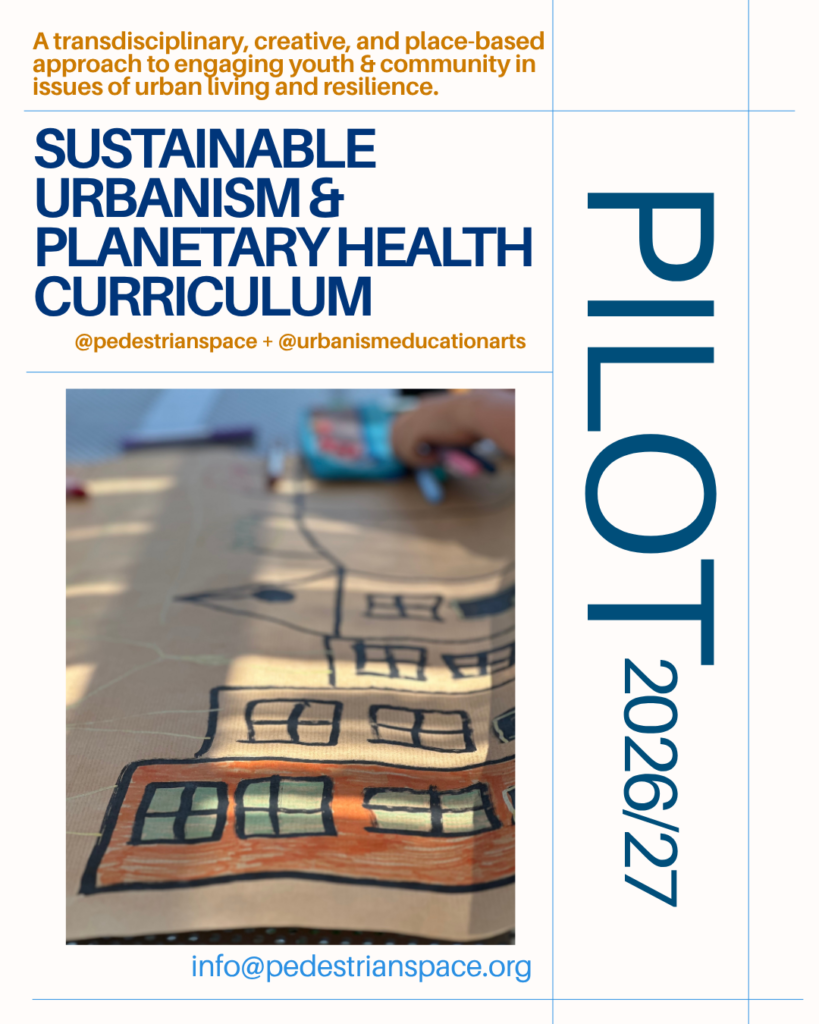
The ‘Sustainable Urbanism & Planetary Health’ curriculum aims to support active and place-based learning about sustainability in urban life and development at a local level and the connections to planetary health at the global level. The curriculum is intended to ‘come alive according to local context’, via place-based education approaches that are geographically and culturally appropriate. The pilots will offer us an opportunity to test out the curriculum as well as produce collaborative research on place-based education in a sustainable urbanism curriculum for primary school students.
Learn more here at the following link, and if you are interested in collaborating, please feel free to DM me or email info@pedestrianspace.org.
-Annika