I’m really excited about this.
It’s also going to take some time.
In the past several months, my husband has said to me (on more than one occasion), ‘Why don’t you just start your own school?’
Well, it makes sense that this guy is my husband, because the flood of endorphins I get from such a suggestion is incredible.
Also, he knows, probably better than anyone on the planet, how wildly busy my mind is and how many projects and engagements I have going on at any given moment (maybe some of you reading this can relate to this). So for him to not only suggest but also encourage something so substantial is very moving to me.
The reality is that I’ve been thinking about a program development for quite some time now. Establishing a school from scratch has not been the vision, though if ‘right timing’ + ‘right place’ with a group of educators and parents presented the opportunity, I would not hesitate.
Our own journey as parents, navigating education systems and special education accommodations for one of our children, has undeniably been a key spark for this.
I also happen to quietly thrill at the prospect of weaving the diversity of my experiences, including in K-12 education, with my community-engaged research approach and interest to create opportunities for project-based, fresh, contemporary, and relevant sustainable urbanism education.
Long before becoming an urban researcher (I am in the fourth and final year of my PhD studies right now, for which my fieldwork was on issues of walkability via a 15-minute city lens in Warsaw, Poland), I worked in various contexts and classrooms in K-12 educational settings, and typically in special education.
I learned over time how much I enjoyed (even preferred) working with students on the Autism spectrum as well as with students with ADHD or ADD diagnoses.
Funny that life would have it that I would, years later, give birth to my first child, who at the age of 3 would be diagnosed with moderate autism.
Our entrance into education systems was characterized by the roller coaster navigation that many parents of children with ‘special needs’ experience in societies all over the world.
As I began to say several years ago, due to our situation, we don’t ‘Think outside the box.‘
In our situation, there is no box.
I am not attached to any ‘alternative’ education ideology. However, I am not opposed to exploring them either, quite the opposite. I’m interested in continuing to learn about diverse educational philosophies and methodologies, including Montessori, Freinet, Reggio Emilia, Steiner, and others, as well as contemporary approaches in different contexts, particularly those that are attuned to zeitgeist transitions and needs, and reflecting that in the day-to-day learning.
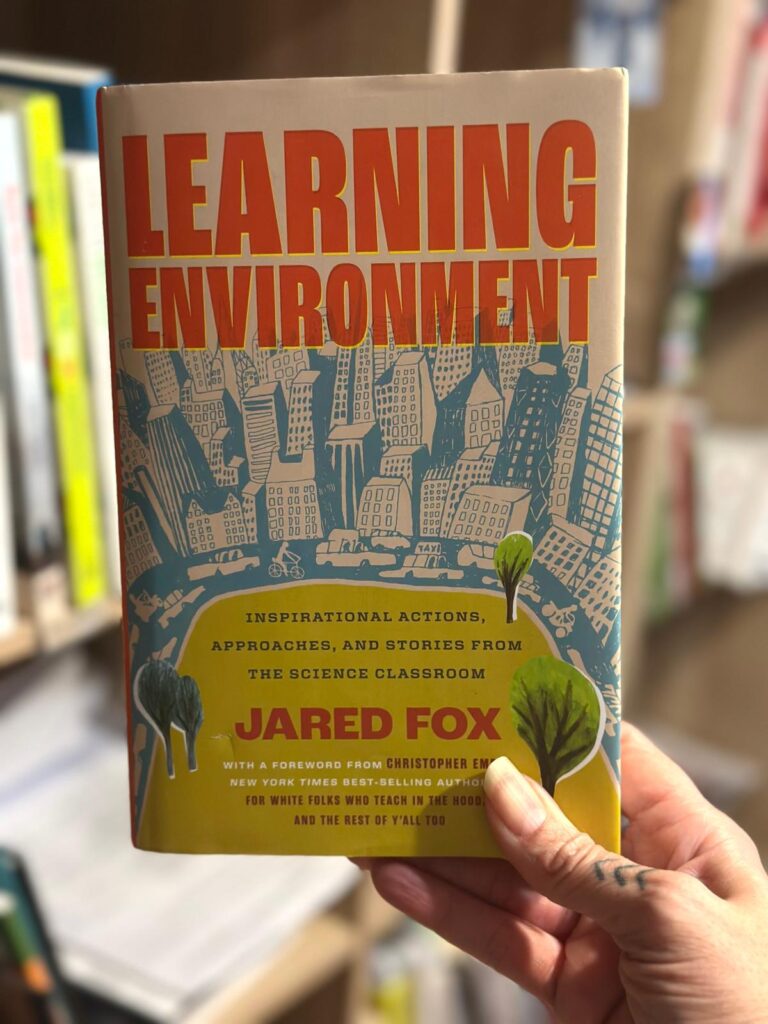
In November of 2025, I happened to sit down at my computer and turn on WNYC Radio – NPR to an interview with author Jared Fox, Ph.D., about his book ‘Learning Environment: Inspirational Actions, Approaches, and Stories From the Science Classroom’. My mind lit up as he discussed the ‘one block lab’ and his teaching methods and approach. I reached out to him nearly immediately and also enjoyed our first chat that month.
I began reading ‘Learning Environment‘ this month. In the Author Notes, Fox reflects that his own curriculum-building process was ‘fueled by my desire to confront environmental (and educational) injustice and equip my students with the knowledge and skills that could empower them to effect meaningful change in their own community.’ This, along with many, many other passages, resonated with me so much. During our live chat last November, I also recall asking Jared how he feels his approach worked for kids who are often not accommodated in mainstream classroom settings. His observation was that the project-based approach allowed many such students to really (and finally) shine.
The book will be cited in the reading resources and bibliography of the curriculum I develop. If you have other reading tips, please feel free to contact me (info at the end of the newsletter).

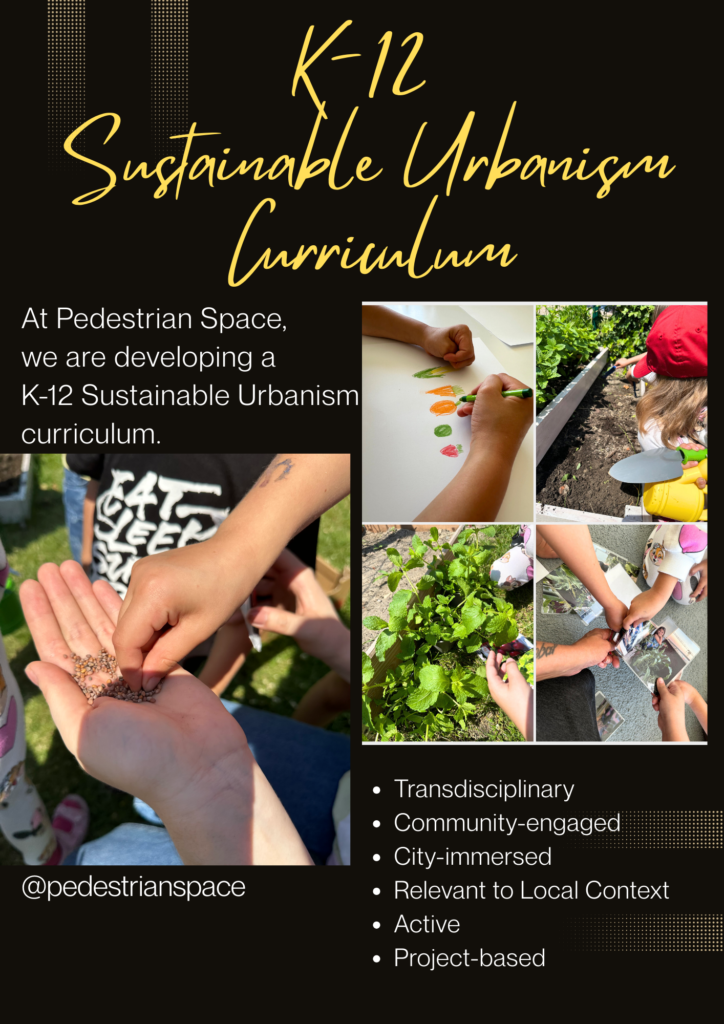
My idea for a Pedestrian Space Sustainable Urbanism curriculum specifically connects to my reality as an urban researcher and founder of an NGO that is committed to media, public awareness-shaping, and education on diverse issues of urban resilience. Operating at the intersection of media, research, education, and advocacy is the raison d’être of Pedestrian Space. Synthesizing these areas into a coherent program, designed by age group modules and with a transdisciplinary, active, and project-based learning approach, is at the heart of the design for this curriculum. The curriculum is meant to serve as extracurricular and/or supplement the teachers’ existing educational plans.
On a personal note, my family and I are actively searching for our next educational and home base, to include a school for our children that hits some key criteria:
- Based in Europe
- Encourages active family and community participation
- Flexible and resilient approach- does not ‘give up’ on children but seeks to accommodate all
- Not exclusively or relentlessly focused on rankings and profit
- Capable and thoughtful accommodation for children with diverse special needs
- Faculty of passionate educators
- Bonus: school garden (or is open to establishing such)
- Bonus: is open to collaboration with Pedestrian Space for a community-engaged Sustainable Urbanism Curriculum
Concerning that last point, that’s right. We are seeking a school not only to enroll our children in, but also that is open to collaboration with Pedestrian Space for this community-engaged and city-immersed Sustainable Urbanism curriculum. Such collaboration can also (should also) be in the form of funded project proposals to help implement the curriculum and involve diverse faculty.
I am interested in being the project coordinator for the curriculum myself, hence why it is important to me that the school is interested in (or already active with) community engagement and participation.
I am looking to pilot the curriculum in the Autumn semester 2026. I am also beginning dialogues with potential international partners, as the bigger picture would be to support the development of this curriculum as a global and public resource, able to be crafted and adapted to local contexts.
We have our first visit to a school in northwestern Poland this month to explore both enrollment and project collaboration.
We have deeply appreciated the different chapters of life we have had here in Poland, as well as the diverse opportunities given, including current partnerships developing. It is very attractive indeed to remain here and continue.
However, we know about the tides of life and how things change. So, as we investigate possibilities here, we are also looking for other potentially ‘good fits’ in schools across Europe.
We hope to make a great transition and landing (fortunately, my husband can work remotely anywhere in Europe), where our children can be well accommodated in a thoughtful and great school and where I can also pilot this program with an enthusiastic and engaged school community and, later, be able to bring the curriculum to a global stage.
I really enjoyed writing this, on a sleepy, grey-skied, snow-covered afternoon here where we live in Poland, while listening to my new favorite Belgrade and Berlin-based radio station: radio.D59B
If you have read this and are interested in sharing about your school or about potential curriculum collaboration, please feel free to contact us via the Pedestrian Space Instagram page, or directly via email: info@pedestrianspace.org.
-Annika