Steps Towards Walkability
by Sandy Yang
Sandy Yang is a high school senior living in New York City. She was introduced to the issue of walkability by her English teachers, and her writing on walkability is inspired by Transcendentalist works as well as her experiences visiting suburbs outside of NYC. She wrote this piece for the course “Writing to Make Change” at her high school. Their task was to write about any topic of their choosing and to send it out into the world.
Looking through the floor-to-ceiling windows of the restaurant, I observe cars pulling in and out of the parking lot. Light gleams off the shiny finishes of the vehicles under the bright Florida sun. Beyond the methodical rows of stationary cars, similar models zoom past in a single file line on a road.
The restaurant lies in a strip mall, which is sandwiched between two parking lots: one for the patrons of the businesses and one that is half the size for employees. The lots take up the same amount of space, if not more, than the establishments here. This arrangement has always been counterintuitive to me—that we would allocate more land for the transitory stay of empty vehicles than the people and livelihoods that the vehicles are supposed to serve. However, it would be a lie to say that the parking lots are useless, because every person who arrives can be traced back to a car sitting in a rectangular space demarcated by three lines of white paint. I don’t even think there is an entrance to the plaza for pedestrians; the only way into the center is on the paved paths for automobiles that connect directly from the road.
These expansive parking lots are a necessary byproduct of the car-centric country we have built and a stopgap to an invisible way that cars are degrading the atmosphere, but they are in no way a pragmatic solution. By now, it is evident to most people that driving gas-powered vehicles emits greenhouse gases such as carbon dioxide, methane, and hydrofluorocarbons (“Greenhouse Gas Emissions”). Much of this emission occurs during the actual driving from one location to another, but it is also important to recognize that “our streets are congested, in part, by people who have gotten where they want to be but are cruising around looking for a place to park” (Shoup 16). Without designated parking places, drivers spend more time on the roads and runtheir cars for longer. The extra mileage and gas emitted from cruising accumulates across multiple drivers: “Over a year, this driving in circles amounts to 1,825 VMT [vehicle miles traveled] for each curb space (5 miles x 365 days), greater than half the distance across the United States” (Shoup 17). This isn’t to say that constructing parking lots is the solution to cruising, however.
I want to see a parent holding their child’s hand and pushing a stroller. I want to see a person dressed in a suit with a briefcase, walking with purpose next to someone in a hoodie and sweatpants who is getting dragged along by their dog.
Sandy Yang
Parking spaces are still incredibly inefficient uses of land, which, in the U.S., take up as much space as Massachusetts (Inci 50). This land could serve much better purposes, such as for recreational spaces like parks or community centers like libraries, places that I find my visits to Florida lack. This imbalance of space is indicative of an overreliance on cars and only one of the additional costs accrued from maintaining an automobile-oriented landscape. The root of these intertwining problems is the lack of walkability in the United States.
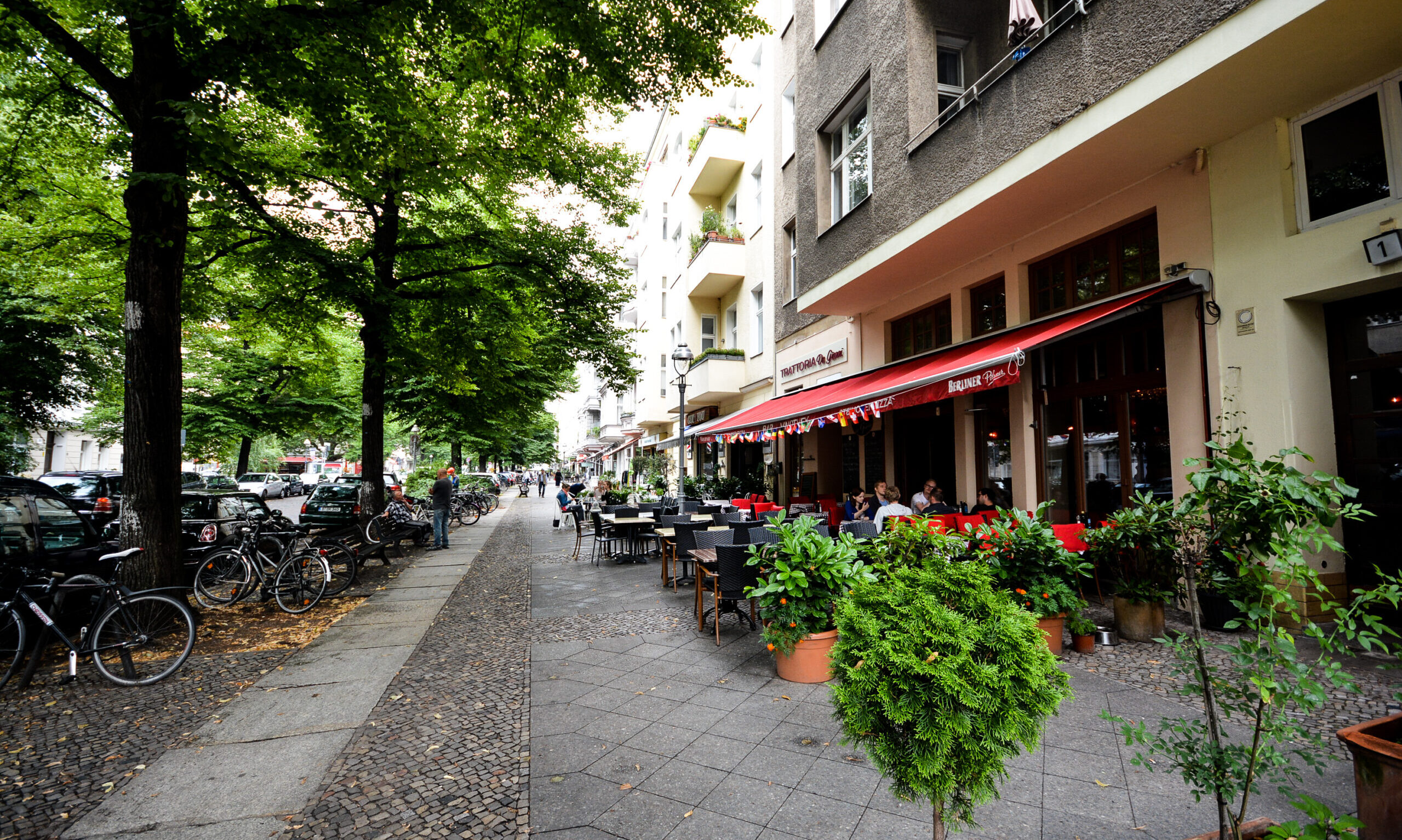
When I leave the restaurant, inevitably in the backseat of a car, I notice that there are no sidewalks lining the roads, just trees and short buildings. Everyone is hidden away in the automobiles that surround us, moving in tandem until the blinking of headlights indicates that they are about to exit the stream of vehicles. This is a stark contrast to the streets I’m used to in Brooklyn, with intersections and blocks of buildings rather than roads that go on for miles with no end in sight. On the rare occasion that we drive somewhere in New York City instead of walking, we drive alongside people and stop every couple of blocks at a traffic light while pedestrians cross in front of us.
Growing up in New York, I assumed that this was the norm: that having the ability to walk to the grocery store or the doctor’s office was a ubiquitous experience. Ultimately, countries should have the structures and regulations necessary to make this the expected instead of the exception because of the environmental, physical, social, and economic benefits of walkability.
As we work towards improving walkability in the United States, the infrastructure we create to facilitate this goal should be accessible and sustainable to support inclusivity and design spaces that everyone can enjoy.
Sandy Yang
In a case study of Mueller, a community in Austin, Texas, whose designers prioritized walkability through “activity-friendly design features, such as high-density, mixed-land uses, well-connected street networks with sidewalks, and rich and diverse natural resources,” residents shared that they had increased levels of physical activity and social interactions (Zhu et al.). Walkability enables people to feel a sense of community by providing them the chance to be a part of something: the feeling that they belong to a society filled with other living, breathing people. People with different backgrounds and destinations are connected by the common goal of getting somewhere, joined together at an intersection, their movement dictated by a timed light.
When I go outside, I want to see groups of teenagers weighed down by backpacks, laughing at some inside joke, and jostling each other. I want to see people carrying grocery bags, heading home after running errands. I want to see a parent holding their child’s hand and pushing a stroller. I want to see a person dressed in a suit with a briefcase, walking with purpose next to someone in a hoodie and sweatpants who is getting dragged along by their dog.
I don’t even think there is an entrance to the plaza for pedestrians; the only way into the center is on the paved paths for automobiles that connect directly from the road.
Sandy Yang
Walking is a cheaper and more reliable form of transportation than driving. In addition to the direct costs of purchasing a car and its complements like gas and maintenance, there is also the aforementioned price of storing vehicles and the gas burned while sitting idly in traffic. After housing, the second-largest sector of a household’s budget is transportation, and households that rely on cars are more vulnerable in economic downturns because of changes in gas prices (America Walks). Not only does walkability dampen the negative effects of business cycles, but it can also promote economic expansion. More people can walk than those who can drive, so establishments that are accessible through walking receive more business (America Walks).
As we work towards improving walkability in the United States, the infrastructure we create to facilitate this goal should be accessible and sustainable to support inclusivity and design spaces that everyone can enjoy. It makes much more sense for people to build systems that prioritize us rather than to treat ourselves as an afterthought. Increased walkability is the solution to the host of problems that accompany excessive dependence on vehicles for travel and is the gateway to better environmental, physical, social, and economic health.
Works Cited:
America Walks. “Economic Benefits of Walking.” Microsoft Word file. americawalks.org/wp-content/uploads/2021/06/9_19_19-AW-Economic-Fact-Sheet_final -1.pdf. Accessed 20 Nov. 2025.
“Greenhouse Gas Emissions from a Typical Passenger Vehicle.” EPA, 12 June 2025, www.epa.gov/greenvehicles/greenhouse-gas-emissions-typical-passenger-vehicle. “Guide to Understanding Vehicle Miles Traveled (VMT).” DOT Compliance Group, 25 Jan. 2024, dotcompliancegroup.com/blog/guide-to-understanding-vehicle-miles-traveled-vmt/. Inci, Eren. “A Review of the Economics of Parking.” Economics of Transportation, vol. 4, no. 1-2, 2014, pp. 50-63, https://doi.org/10.1016/j.ecotra.2014.11.001.
Jaworsky, Amanda. “The Economics of Parking.” Michigan Journal of Economics, 20 June 2022, sites.lsa.umich.edu/mje/2022/06/20/the-economics-of-parking/.
Shoup, Donald. “Cruising for Parking.” ACCESS, no. 30, 2007, pp. 16-22, shoup.bol.ucla.edu/CruisingForParkingAccess.pdf. Zhu, Xuemei, et al. “Walkable Communities: Impacts on Residents’ Physical and Social Health.” World Health Design, vol. 6, no. 3, 2013, pp. 68-75, pmc.ncbi.nlm.nih.gov/articles/PMC8776244/.
Writing to Make Change is a junior/senior writing workshop course in which students generate and craft public writing for a larger audience. Over the course of one semester, students read work in a variety of genres and use those texts as models, identifying issues they are passionate about and forms they would like to explore. We host a number of guest speakers who inspire us to write and publish, and each student drafts, revises, and sends out at least one piece of public writing into the world to make change on an issue that matters to them. –Annie Thoms, English teacher, Stuyvesant HS